There is a perception that airports are merely a facility that is made of terminal buildings, runways, taxiways, some stores, food & beverage outlets, and some service-related entities.

But forward-looking airports, which have aggressive growth rates, compete with other airports just like any other industry. As in any competitive market, evaluation is important. When I decided to write this article, I had to ask myself two questions: How do you evaluate airport competitiveness, and why would you want to?

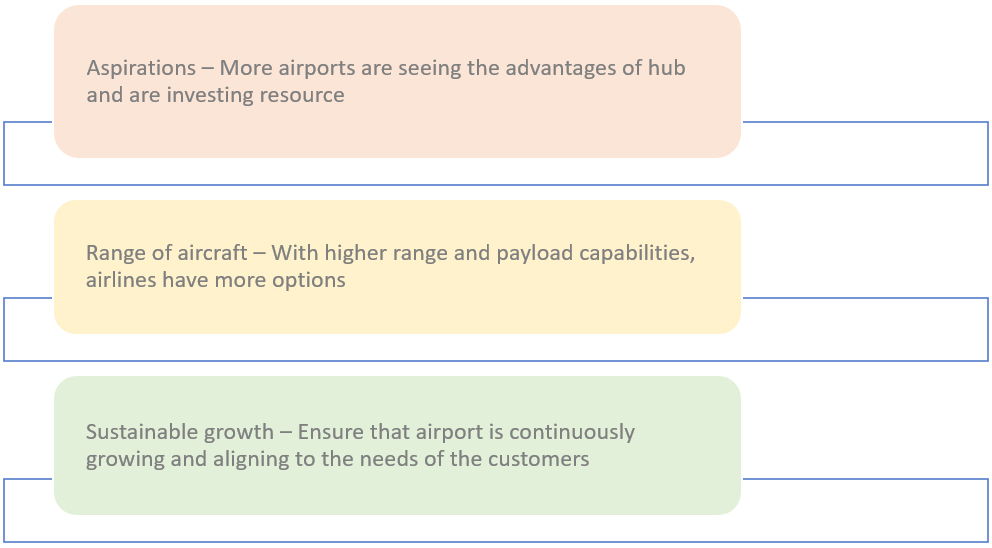
The first and foremost reason is that a lot of airports are seeing the positive economic impacts of having strong hubs and how they contribute towards the economy, so a lot of airports have aspirations and are investing resources to create hubs. So, a competitive-minded airport always has to ensure that their hub is at the leading edge compared to other airports in the region.

Second, as new aircraft have higher range and payload capabilities, airlines can bypass the hubs and operate instead at secondary airports, so it is essential that each hub is offering efficiencies and attractive pricing structures so that airlines don’t have the motivations to bypass hubs.

Third is that consumer preferences are always changing, and new generation is very demanding, so hubs have to ensure that they align their new products and services with changing expectations. These may be cashier-less stores, contactless experiences, or mobile check-in and boarding to meet the ever-growing needs of the customer base.
Airports compete on many metrics, including the number of airlines operating to the airport, number of direct routes, number of originating and transfer passengers, turn-around times of aircraft, on-time performance, passenger convenience in terms of queue times at check-in counters/security, boarding gates, and so much more.

Succeeding in all of the above metrics means more flights attracted, which means more income, more retail sales, and more duty-free revenue, more parking fees, and so on. Hence, more revenue and more potential for profits.

So, when there are so many measures of competitiveness, and as competitiveness is a serious factor in sustainable growth, there is a need to have a scientific and analytical approach to evaluate airport competitiveness, and that’s where the airport competitive index (ACI) comes in. Additionally, it doesn’t hurt to have a little back-up when bragging about how good your airport is.

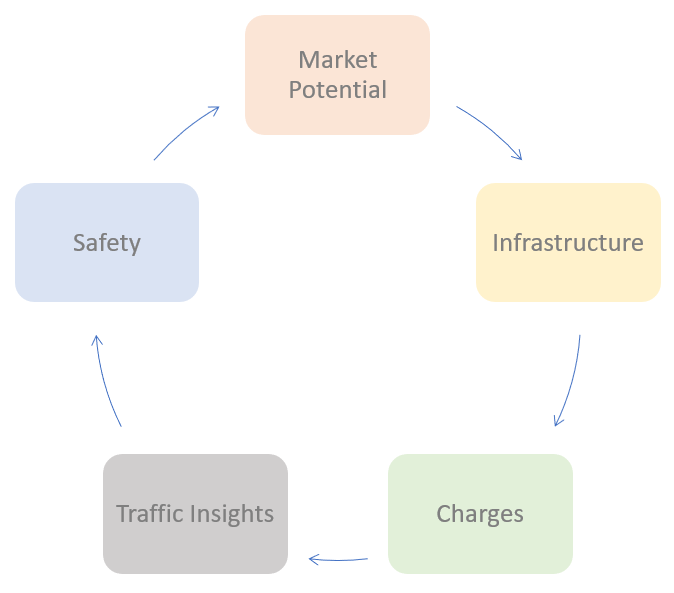
ACI is a scientific and analytical tool that can be used do an apple-to-apple comparison between airport competitors by looking at various factors. The following diagram shows the five key factors that make up the airport competitive index.
These five indicators (market potential, infrastructure, charges, traffic insights, and safety) help us to understand the strengths and weaknesses of our airport in relation to our competitors and identifies what steps need to be taken for sustainable growth and to be ahead of the curve. These indicators also help create a competitive index of all competing airports, so that we can have an apple-to-apple comparison of industry players.

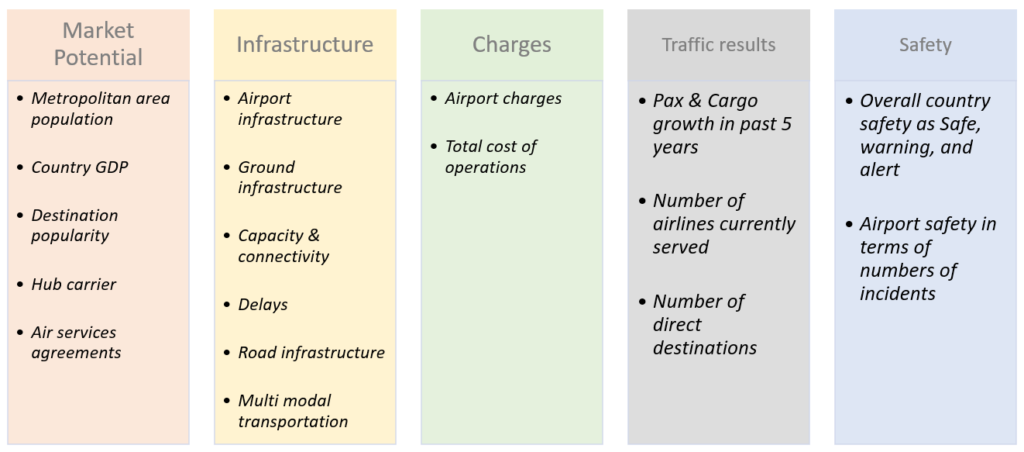
Let’s take a closer look at what these five factors are made of.
Market potential relates to components like GDP, population, destination attractiveness, and several other components that speak to the strength of the market. This is a very important group of indicators, as it determines the available growth market for airlines.

The second category is infrastructure, and good infrastructure is one of the most important factors of any transportation network. For airports, the two components of infrastructure are airport infrastructure and ground infrastructure. Airport infrastructure includes runways, taxiways, ramps, terminals, and other facilities in direct control of the airport. Ground infrastructure consists of road and rail networks connecting the airport to the metropolitan areas in the region.

An important factor when considering airport competitiveness are airport charges. As airport charges mean costs for airlines and revenue for airports, their amount has to be carefully considered and balanced. According to general rules of market economy, economic subjects normally search for the lowest price for comparable level of services. The same principle is more-or-less valid in the air transportation market. Airlines, especially low-cost airlines, exercise high pressure to keep airport charges low.

Now moving on to the traffic insights. Any analysis of competitiveness would be incomplete without adding the factor of achieved results into the model.

With this in mind, three different indicators need to be evaluated. The first indicator is looking at the total number of passengers passing through the airport and looking at annual growth rates.

The second indicator is looking at the number of airlines operating at the airport, as each airline brings certain new destinations and connections into other regional hubs. Last and not the least is the number of direct destinations from the hub, as that offers unique city pairs and will attract a higher number of both O&D and connecting passengers.

The final, and perhaps most important category is the safety coefficient. The first component is the host country’s safety and is derived from the fragile state index. This is a competitive metric because passengers will be less motivated to travel through countries which have various security alerts or deemed unsafe to travel. The second component is the airport safety itself, which relates to number of incidents or accidents that happened at the airport.

In conclusion, the first step to creating your own ACI is to decide which components are most relevant to you and will be used. Once this is done, then the hard part comes and that is collecting data that is from a proper source and validating it. Once these two steps are completed, then an index model can be created, populated with data from competitor airports, and evaluated. The index provides great insights in the areas of strengths, weaknesses, competitive standing, and where improvements are needed.

I hope that this article and framework will help your airport in evaluating its competitiveness, and if you need any help developing a unique model for your needs, please feel free to contact me.


Thank you.
This article is in continuation of my previous insights into global seat capacity. Past issues can be found posted on my LinkedIn profile.

As the global aviation situation is so volatile, I thought it would be interesting to look at how the seat capacity is trending and see the monthly adjustments that are being made between what is filed two months before operation and the extent of adjustments in the month of operation. The difference between these two metrics will show how the current reality compares to initial assumptions, a perspective not commonly reported on.

Currently, in Q4 2021, there are still considerate amount of travel restrictions in place worldwide, and with various regions going through the fourth wave of the pandemic and the market being fluid, there was a downward adjustment in seats for October compared to what was initially planned for October in the month of September.
During the month of September, a total of 385.1 million departing seats were planned for October, and as of October 18, the seats have been reduced to 351.6 million, a reduction of 33.4 million seats and an 8.68% decrease, which indicates the demand is still soft and fluid.

 Looking ahead to November, the same downward adjustment can be seen. There has been a reduction of 38.6 million seats and a 9.78% reduction from what was filed in September.
Looking at the above regional trends, the most significant capacity adjustments have been in Australia with -36.44% and in Asia with -14.59%. These are the same two regions with the highest adjustment as was found in last month’s analysis. Both regions are going through various restrictions and lockdowns and are therefore seeing significant capacity adjustments.

 The following examples showcase national policies in various countries that are influencing international air travel especially in Asia and Australasia. On September 27, Australian authorities announced reopening plans that would give vaccinated citizens more freedoms than those who are unvaccinated. While not explicitly stated, this could create more opportunities for vaccinated travellers to enter and exit the country. Japan maintains a border closure policy for most travellers as case numbers and hospitalizations continue to rise. Similarly, Vietnam’s borders are closed to all non-essential travel. Entry into Malaysia is not possible for non-residents, while Malaysians are able to return home with a negative test result and mandatory quarantine. South Korea continues to allow international travel, as long as inbound travellers complete a mandatory quarantine period.

Policy decisions continue to play a major role in the recovery of the aviation industry. As we have seen throughout this article series, seat capacity adjustments are being made on a monthly basis. Even though we are seeing these tactical adjustments, the pace of overall recovery is still encouraging. Further recovery and growth will be dependent upon the total population being vaccinated, health and travel restrictions, and government policies. These things are the backbone of overall economic recovery and therefore the recovery of all industries, especially aviation.

We will continue to monitor monthly trends and will share updates next month. In the meantime, if you have any queries or want to discuss a specific subject, please feel free to connect with me.

Thank you.
In August, I released an article that reviewed trends in airline seat capacity over the summer. Since then, I noticed significant changes to the projected data, and I decided it would be a good idea to revisit this subject on a monthly basis going forward. Within this edition, we will review how global seat capacity is trending for September and if there has been a positive or negative adjustment from the earlier industry projections.
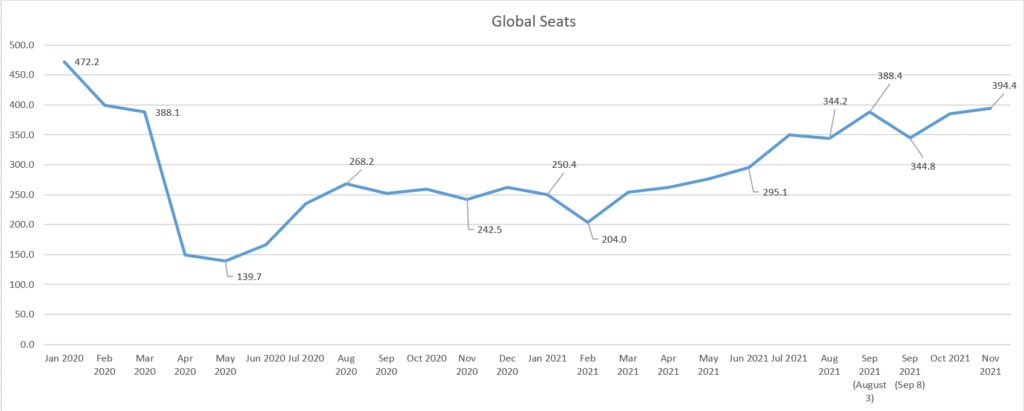
In the first week of August, the September capacity was filed and projected to be 388.4 million seats. However, now that we are in September, we are seeing a downward adjustment to 344.8 million seats, which is a reduction of 43.5 million seats, or 11% (data gathered September 9, 2021). The following table shows the capacity adjustment for the month of September based on global region.
Globally, the highest declines were in Asia, which experienced a reduction of 26 million seats (-18%), and in Australasia, which declined by 4.2 million seats (-51%). While these two regions were the most severely impacted, there was capacity adjustments in every single region, which shows that there is still uncertainty in the global aviation industry, and the COVID-19 pandemic continues to impact travel demand, which is leading to capacity adjustment.

Global airline seat capacity is projected to be at 385 million seats in October and 394 million seats in November, a modest increase from where we sit now in September. As we have seen based on the August projections, demand is fluid, and it is likely that seat capacity in Q4 will trend slightly lower than these figures as time goes on.

Stay tuned for an updated article in October as we check back in on actual capacity compared to these projections.
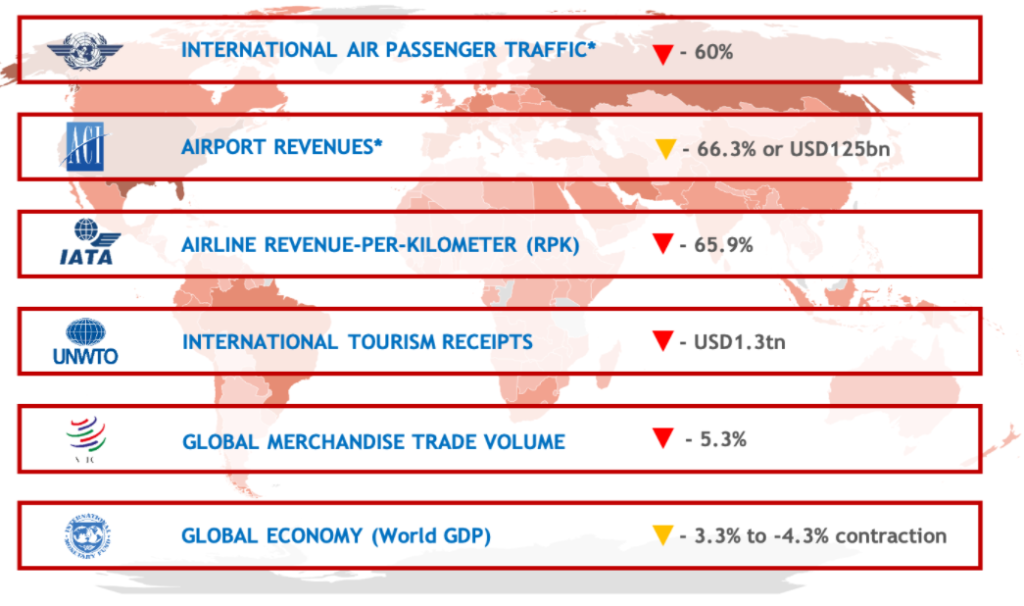
The COVID-19 virus has spread worldwide without acknowledging borders. It has impacted all industries, all sectors, and all aspects of our lives with devastating blows to economies, financial losses, and significant uncertainties. Aviation has been one of the hardest hit industries. International air traffic had reduced by more than 60% in 2020 as compared to 2019, and as you can see in the image below, the financial impacts are astounding.
This industry’s recovery is going to be slow amid various pandemic waves and lockdowns, and it’s projected that it’s going to take two to three years for global traffic to return to 2019 levels.

The aviation industry is a highly resource- and capital-intensive industry, and it’s quite evident that the traditional ways of decision-making will not work going forward, whether that is capital investments for aircraft purchases or airport expansion or maintenance, new route development, operational efficiencies, or asset or resource utilization and allocation, to name a few.

This is where data-driven decision-making is so critical in aviation. But before we get into that model, let’s begin by looking at the traditional organizational decision-making models.

 Organizational decision-making refers to making choices among alternative courses of action — which may also include inaction. Therefore, increasing effectiveness in decision-making is an important part of maximizing effectiveness in business. There are various decision-making models that can help organizations make effective decisions, including:

1.     Rational decision-making model. Follows a general approach, such as defining the problem, identifying criteria for decision making, listing possible solutions, evaluating alternatives, and determining the best solution.

 2.     Bounded rationality decision-making model. You can use bounded rationality when you don't have enough time or information to follow the full rational decision-making model. Sometimes it's better to have a good enough decision sooner vs. a "perfect" decision that's delayed.

 3.     Vroom-Yetton decision-making model. The first part of this model uses seven yes-or-no questions. The answers to these questions then guide you toward one of five decision-making processes to use. Options range from making the decision based on what you know now without consulting your team to reaching a group consensus with your team.

 4.     Intuitive decision-making model. Intuitive decision-making model yields good results when you're dealing with areas where you have a lot of expertise or experience. But in the current environment where there are so many moving pieces, this might not produce the desired organizational results. Nevertheless, it’s quite surprising that this model is still extensively used.

 5.     Recognition-primed decision-making model. This is quite similar to the intuition-based model. Like the intuitive model, the recognition-primed model works best in situations where you can draw on deep experience or expertise. In those cases, it's an especially handy model to use when you are pressed for time.

Now that we have gone through various decision-making models (which are quite subjective in nature), lets talk about the data-driven decision-making (DDDM) models.

First let’s start with what does it mean to be “data-driven?” This term describes a decision-making process that involves collecting data, extracting patterns and facts from those data, and utilizing those facts to make inferences that influence decision-making.

Data-driven decision making (or DDDM) is the process of making organizational decisions based on actual data rather than intuition or observation alone. Data-based business decisions arise from a complex process that involves people, relationships, analytics, culture, software, and problem-solving.

Having data on-hand empowers you to answer crucial business questions such as: “why?”, “how to sell?”, “how to grow your business?”, “how to understand customers?”, “are customers going to buy your new product?”, “where to invest?”, “what differentiates your product?”, etc.

Data-driven aviation organizations can gain a range of benefits such as: a better understanding of the market, which new routes to start, greater customer acquisition and retention, operational efficiencies in terms of turn-around-times and on-time performance, lower costs, higher profitability, and improved pricing.

The following diagram outlines the key steps followed in a data-driven decision-making model.
Not all organizations have implemented DDDM. As with all organizational changes, some businesses and industries are quicker to adapt to new methods. Within the aviation industry, we are seeing many different companies adopting DDDM in their operations. Some characteristics of aviation organizations that effectively implement DDDM are:

·      They understand the data very well. They know where the data came from, its quality,  the best data analysis methods, how reliable the data is, how to measure its reliability, etc.

·      They stimulate the ongoing sharing of information and collaboration. Everyone in the organization has access to the appropriate data.

·      They keep their data clean. The data must be well organized, documented, and error-free. With the help of the right data cleansing approaches, companies make a good basis for decision-making.

·      They have the right set of tools and skills to make insights into structured and unstructured data and thus to come up with strong business decisions and make predictions.

·      They pay serious attention to data collection tools and processes as primary elements of the whole data environment.

·      More importance is given to data and analysis rather than having the perfect infrastructure

·      Data-driven businesses are able to apply the insights in a manner that supports business goals.

By adopting a DDDM and following these characteristics, aviation-based organizations can position themselves for economic recovery after one of the worst downturns to ever hit the industry. New data-gathering technologies are being developed and implemented around the world to provide organizations data on their customers, freight, finances, and much more. Taking advantage of these tools is key for any industry, and especially the aviation industry, if they want to increase the speed and efficacy of recovery.

References

Atlassian. (n.d.). 5 decision-making models to try if you're Stuck: Team Central. Atlassian. https://www.atlassian.com/work-management/strategic-planning/decision-making/models

ICAO. (2021). Economic impacts of covid-19 on civil aviation. Economic Impacts of COVID-19 on Civil Aviation. https://www.icao.int/sustainability/Pages/Economic-Impacts-of-COVID-19.aspx

Miller, K. (2021, April 23). Data-Driven decision making: A primer for beginners. Northeastern University Graduate Programs. https://www.northeastern.edu/graduate/blog/data-driven-decision-making/

Valcheva, S. (2020, May 24). Data driven decision making in business: Process and model. Blog For Data-Driven Business. https://www.intellspot.com/data-driven-decision-making/

https://www.mercurymediatechnology.com/en/blog/how-to-really-transition-to-data-driven-decision-making/
The COVID-19 viral pandemic continues to have unprecedented globally shared phenomena with wide-ranging repercussions. The pandemic has disrupted lives across all countries and communities and negatively affected global economic growth in 2020 beyond anything experienced in nearly a century. High-level estimates show that the global economy during 2020 reduced to an annualized rate of -3.4% to -7.6%, with a recovery of 4.2% to 5.6% projected for 2021.

Gross domestic product, colloquially known as GDP, is the accumulated value of all finished goods and services produced in a country and is measured annually. GDP is regarded as an indicator in determining the economic health, growth, and productivity in a country.
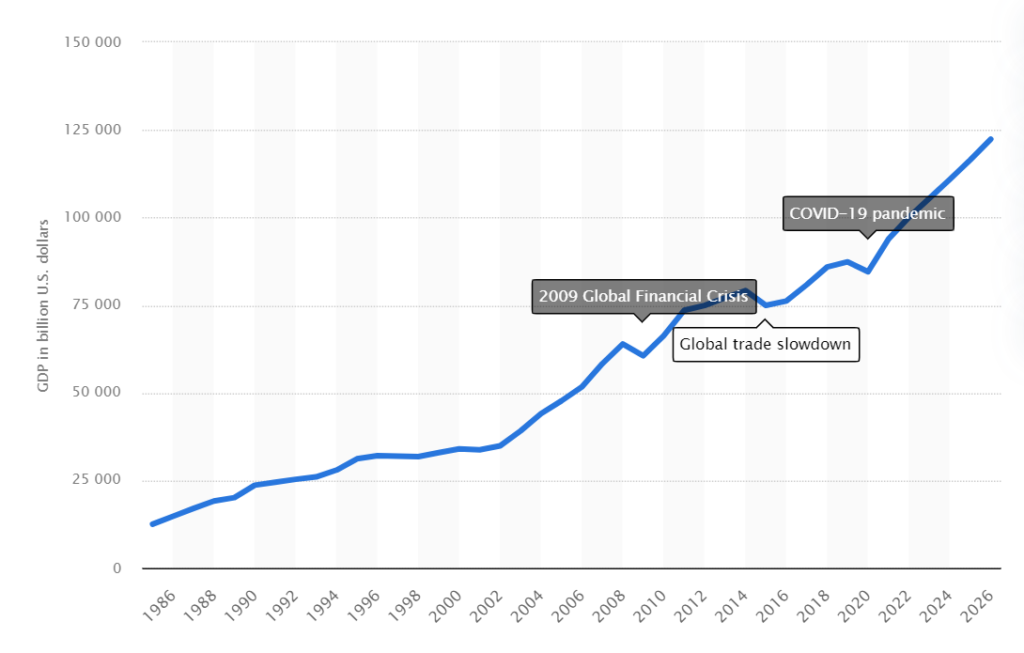
The above graph shows the US GDP in billions of dollars from 1986 with projections through 2026. There was a major impact on global GDP in 2009 due to the global financial crisis during which the global GDP came down to $60.5 trillion from $63.9 trillion. The COVID-19 pandemic also had a significant impact in which the GDP came down from $87.3 trillion in 2019 to $84.5 trillion in 2020. This was a reduction of 3.22% or $2.8 trillion.
Global stock markets have also suffered due to the coronavirus outbreak, although they were able to recover from the losses quite quickly. The Dow Jones reported its largest single day loss of almost 3,000 points on March 16, 2020 – beating its previous record of 2,300 points that was set only four days earlier.
The economic damage caused by the COVID-19 pandemic is largely driven by a fall in demand, meaning that there are less consumers willing to purchase the goods and services available in the global economy. One of the main industries that has suffered by this is travel and tourism. To slow the spread of the virus, countries have placed various health and travel restrictions and due to less demand, airlines had to cut the number of flights offered, which led to job cuts and the decrease of various economic impact drivers.
The same dynamic applies to other industries. For example, a reduction in demand for oil and new automobiles was seen as daily commutes, social events and holidays became no longer possible. As companies start to reduce employment as one tactic to make up for lost revenue, the worry is that this will create a downward economic spiral when these newly unemployed workers can no longer afford to purchase as many goods and services as before.
Despite all these challenges, global GDP in 2021 is expected to grow by 5.6% and a reasonable growth is projected for the next three years as well. The main countries driving this growth are the US and China. The United States and China are each expected to contribute about one quarter of global growth in 2021. The US economy has been bolstered by massive fiscal support, vaccination is expected to become widespread by mid-2021, and GDP growth is expected to reach 6.8% this year, the fastest pace since 1984. On the other hand, China’s economy – which did not contract last year – is expected to grow by 8.5% as the country’s focus shifts to reducing financial stability risks.
In order to make the economic recovery sustainable and global, some of the key drivers needed would be:
· Higher percentage of global population getting fully vaccinated.
· Continuous government stimulation to ensure business recovery which will in turn reduce the unemployment rates.
· Maintaining inflation within an acceptable range so that prices do not increase significantly and burden people with limited resources.
On the other hand, a more persistent pandemic, a wave of corporate bankruptcies, financial stress, or even social unrest could derail the recovery. As is true in any facet of a functional society, it will take a dedicated, collective effort to breathe life back into this global economic recovery.
We all know that aviation has been one of the hardest hit industries due to COVID-19. Total passenger traffic declined by more than 60% during 2020, devastating airlines, airports, and all aviation-related organizations.

But as restrictions are being lifted in many parts of the world and economies opening back up, there is cautious optimism that aviation is recovering at an accelerated pace.

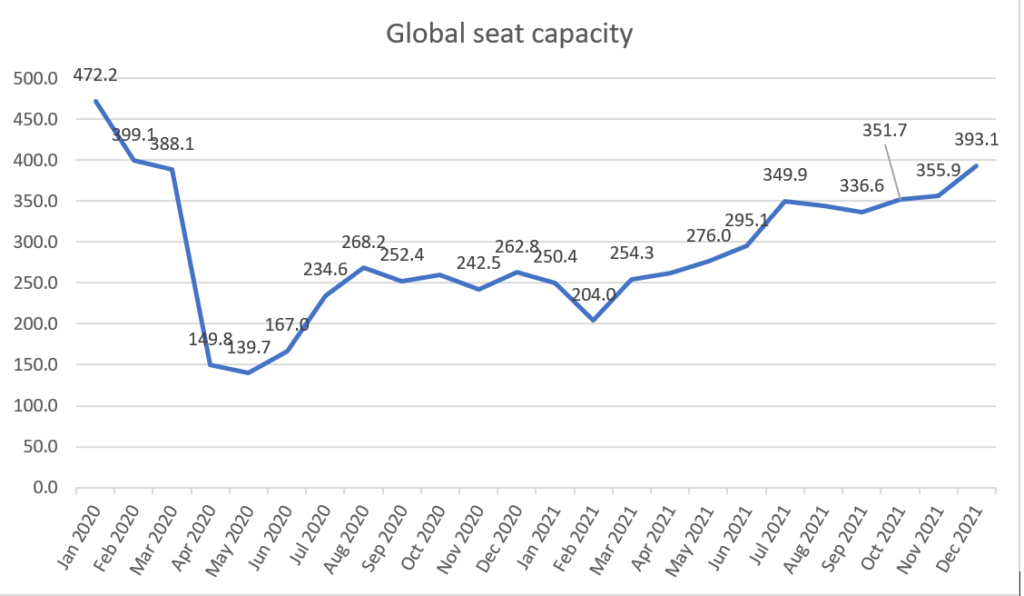
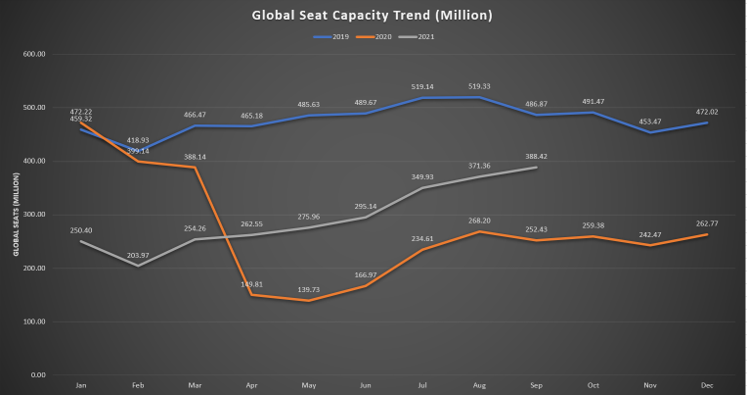
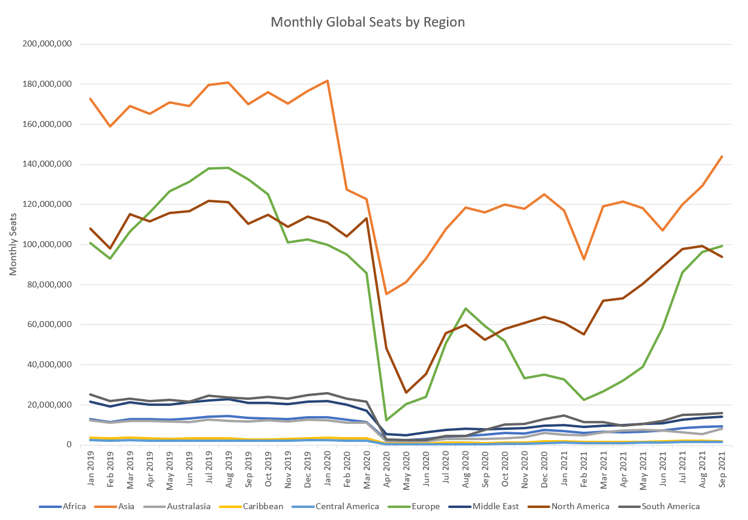
The summer of 2021 has been quite encouraging, with a global seat capacity for August 2021 expected to reach 371 million seats, and September projected to hit 388 million seats (data as of August 4, 2021), the highest since the beginning of the pandemic in 2020. This is a growth of approximately 178% from the lowest point of COVID (May 2020).

To provide more context, during pre-COVID times, the highest per month seat capacity in 2019 was during July and August at approximately 519 million seats. The true global impact of COVID started in March 2020, when seat capacity dropped to 388 million seats monthly, and then eventually in May 2020 plummeted to 139 million seats, the lowest during pandemic and a decrease of 73% compared to 2019’s peak month, August.
Since then, it has been a roller coaster ride with various waves of COVID forcing countries to slingshot between closing and opening their economies. Different national restrictions have led to specific countries and continents experiencing different rates of recover in the aviation sector.
In the graph above, it is clear that all regions, especially Europe, Asia, and North America, experienced a major decline in seats in the spring of 2020, and are now seeing a rebound. By the numbers, Europe is seeing the fastest increase; in May 2021 it had 39 million monthly seats, and in August it is expected to have 96 million seats, an increase of 147%. Within the same timeframe, South America increased 45% from approximately 10 million to 15 million, and Central America increased 35% from 1.2 million to 1.6 million. However, not every region is experience such good fortune. Australasia is still experiencing challenging times, and capacity decreased by 31% between May and August 2021, from 7.6 million seats to 5.3 million.

Overall, there is a global growth trend through August and September, and the aviation industry is optimistic that this trend will continue through Q4 and into 2022 as more of the global population gets vaccinated, more borders open to international travel, and restrictions are eased and removed.
We have all heard the phrase that data is the new oil, but to leverage this great resource we need to ensure that there is a full-fledged strategy in place to take advantage of its benefits, and that’s where a data strategy comes in.

COVID-19 has had a significant impact on global passenger traffic and according to International Civil Aviation Organization (ICAO), global passenger traffic declined by more than 60% due to the pandemic. There are still countries that are facing third and fourth waves, and the projections are that its going to take 3 to 4 years for passenger traffic to return to 2019 levels. This puts huge financial constraints on airlines and airports, and it becomes immensely important that each dollar spent, or each new program or project initiated gives the optimized return on investment and increases the economic value of the organization. This can be achieved through data-based decision-making, and data strategy is the core to it.

This article will explore what data strategy is and how airlines and airports can go about developing and implementing a data strategy.

Data Strategy Defined

 A data strategy is a common reference of methods, services, architectures, usage patterns, and procedures for acquiring, integrating, storing, securing, managing, monitoring, analyzing, consuming, and operationalizing data. In layman’s terms, one can say it deals with anything concerning data. A data strategy also helps organizations make informed decisions based on data, keep data safe and ensure compliance with various laws and regulations.

While each organization’s data strategy will look a bit different, some guiding principles for an airline and airport may include:

·      The organization’s data support fact-based decision-making.

·      Data is comprehensively integrated.

·      Data is appropriately accessible and available to support timely consumption and insight generation.

·      Data definitions are consistent and are maintained and managed to support data users.

·      Data owners and data stewards are accountable and responsible for their domains.

·      Data is managed (curated, retained, archived, disposed) across its lifecycle.

·      Data is appropriately secured across its lifecycle.

·      Data is governed.

Why Do Airlines and Airports Need a Data Strategy?

The volume and variety of data that organizations have been collecting and producing have been growing exponentially and show no sign of slowing down. At the same time, business landscapes and models are evolving, and users and stakeholders are becoming more and more data-centric, with maturing and demanding expectations.

The data strategy will serve as the mechanism for making good-quality and well-governed data readily available and accessible to deliver on the organization’s goals and objectives. It will also assist stakeholders like partner airlines and airports, ground handling companies, travel agents, cargo agents, security agencies, customs, and border controls, air navigation service providers, multiple levels of government, and civil aviation organizations to access the right data and to make the right decisions in the interest of the whole aviation ecosystem.

The idea behind developing a data strategy is to make sure all data resources are positioned in such a way that they can be used, shared, and moved easily and efficiently. Data is no longer a by-product of business processing – it is a critical asset that enables processing and decision making. A data strategy helps by ensuring that data is managed and used like an asset. It provides a common set of goals and objectives across projects to ensure data is used both effectively and efficiently. A data strategy establishes common methods, practices, and processes to manage, manipulate and share data across the enterprise in a repeatable manner.
Key Components of a Data Strategy

 To ensure that the data strategy drives the organization’s vision and mission, some of the necessary components that it should include are:

·      Vision and Goals: Key outcomes that will be achieved through a data strategy, and clear-cut goals as to how a data strategy will help the organization achieve its objectives and create a sustainable competitive advantage.

·      Current State: Details of business operations and technical implementations that capture how the organization’s data operations function today. This is then used to evaluate airlines’ and airports’ enterprise-wide capabilities and maturity in the context of the data strategy vision.

·      Future state: The desired future state with tangible outcomes of how a data strategy will create a competitive niche for airlines or airports.

·      Governance Model: Data standards, procedures, and compliance criteria that the aviation organization must adhere to for regulatory reasons or any other standards that the organization wishes to adopt. Another key element is the methods and standards by which change across the data strategy scope is introduced, evaluated, confirmed, conformed into the iterative evolution, and communicated to stakeholders.

·      Reference Architecture: A good reference architecture considers existing or legacy standards and implementations and allows for new standards and innovations to be integrated. The key aspects of a data architecture include architectural design principles, domain and function model, design patterns, tool mapping, function matrix, and others.

·      Data Management Roadmap: This is one of the most important components of a data strategy. The roadmap relates to the planning, execution, and oversight of policies, practices, and projects that acquire, control, protect, deliver, and enhance the value of data and information assets. Key areas that need to be addressed in data management are data security, data quality management, data operations management, metadata, data modeling & design, data risk management, and others.

Final Thoughts

I mentioned at the start of this article that data is referred to as the new oil – a valuable resource that fuels economic development. The difference between gathering data and natural resources is that any organization can do it, and when the data is used to enhance organizational value and create a sustainable competitive advantage, it can set a business apart from the competition. Whether you are a small airport that serves only local routes, or a global airline with hundreds of millions of annual passengers. Data is all around us, and it is key to staying relevant and successful in the digital age.

References

DXC Technology, Defining a Data Strategy. https://www.dxc.technology/analytics/insights/143882-defining_a_data_strategy_an_essential_component_of_your_digital_transformation_journey

Infotech.com. www.infotech.com
What is Data Mining?

In general terms, “Mining” is the process of extracting some valuable material from the earth, such as coal mining, diamond mining etc. In the context of analytics, “Data Mining” refers to the extraction of useful information from a bulk of data sources or data warehouses. One can see that the term itself is a little bit confusing. In coal or diamond mining, the result of extraction process is coal or diamond. But in the case of Data Mining, the result of the extraction process is not data! Instead, the results of data mining are the patterns and knowledge that we gain at the end of the extraction process. In that sense, Data Mining is also known as Knowledge Discovery or Knowledge Extraction.
Data Mining is the art and science of discovering knowledge, insights, and patterns in data. In practice, it is the act of extracting useful insights and patterns from either an organized and structured or unstructured collection of data. Data Mining is a very broad and multidisciplinary field that borrows techniques from variety of areas. For example, it uses the knowledge of data quality and data organizing from the database area, draws modeling and analytical techniques from statistics, and the art of decision-making from business management.

Data Mining in the Aviation Industry

We are in the information economy, and more and more data are being generated each second. Every time you buy a plane ticket or hotel stay, rent a car or travel on your dream vacation, purchase goods in-flight or in the airport, or walk through the terminal, valuable data is being generated and downloaded to a database.

Aviation organizations are storing, processing, and analyzing this data to gain intelligence and improve their decision-making. This is where data mining comes in. Data mining is the incorporation of quantitative methods or mathematical methods that may include equations, algorithms, logistic regression, neural networks, segmentation and classification, clustering, and other methods that use mathematics. Generally, wherever you have processes and data, it is the application of these powerful mathematical models incorporated with certain statistical techniques that will help extract insights and patterns for business-planning and decision-making.

How Data Mining Happens

There are various steps that can be taken, but some good practices within the aviation industry are:

 1.     Business Understanding

The first step is establishing the goals of the project and identifying how data mining can help achieve them. A plan should be developed at this stage to include timelines, actions, and role assignments.

2.     Data Understanding

Data is collected from all applicable data sources in this step. Always remember that relevant data is the key and understand that secondary data is equally essential as well. Data visualization tools are often used in this stage to explore the properties of the data to ensure it will help achieve the business goals.

3.     Data Preparation

Data is then cleansed; quality management principles are applied, and missing data is included to ensure it is ready to be mined. Data processing can take enormous amounts of time depending on the amount of data analyzed and the number of data sources. This can sometimes be the most time-consuming step.

4.     Data Modeling

Mathematical models are then used to find patterns in the data using sophisticated data tools.

5.     Evaluation

The findings are evaluated and compared to business objectives to determine if they should be deployed across the organization.

6.     Deployment

In the final stage, the data mining findings are shared across the organization. An enterprise business intelligence platform can be used to provide a single source of the truth for self-service data discovery.

Types of Data Mining in Aviation

Depending on an airline’s or airport’s maturity in analytics, the two primary types of data mining practices used are Supervised Learning and Unsupervised Learning.

1. Supervised Learning

Aviation organizations use supervised learning when their goal is prediction or classification. A process is considered supervised learning if the goal of the model is to predict the value of an observation. The easiest way to conceptualize this process is to look for a single output variable. Some examples are predictive aircraft maintenance and route forecasts. Common analytical models used in supervised data mining approaches in aviation are: Linear Regressions, Logistic Regressions, Time Series, Classification or Regression Trees, Neural Networks, and K-Nearest Neighbor.

2. Unsupervised Learning

Unsupervised tasks focus on understanding and describing data to reveal underlying patterns. Recommendation systems employ unsupervised learning to track user patterns and provide personalized recommendations to enhance the customer experience. In aviation, this is used to understand customers’ buying behaviors or perform association analyses. For example, certain segments of passengers, when buying an airline ticket, will also buy hotel accommodation and rental cars. Common analytical models used in unsupervised data mining approaches are: Clustering, Association Analysis, Principal Component Analysis, Supervised and Unsupervised Approaches in Practice.

In Closing

We have all heard the saying that data is the new oil. Well, I like to say that it’s the new jet fuel. Whatever analogy we use, data just sitting there untouched does not do anyone any good. It needs to be mined and applied to various business operations to improve efficiencies, enhance the customer experience, and increase revenues.

References

https://www.microstrategy.com/us/resources/introductory-guides/data-mining-explained

https://www.geeksforgeeks.org/data-mining/

https://www.karmelsoft.com/every-company-has-to-overcome-to-succeed-in-data-mining

https://www.greenbiz.com/article/bmw-first-carmaker-join-responsible-mining-initiative
The Fourth Industrial Revolution represents a fundamental change in the way we live, work and relate to one another. It is a new chapter in human development, enabled by extraordinary technology advances commensurate with those of the first, second and third industrial revolutions. These advances are merging the physical, digital and biological worlds in ways that create both huge promise and potential peril. Digital tools, automated services and data-driven decisions – these are the theoretical building blocks of the Fourth Industrial Revolution.

There are roughly 20 billion devices connected to the internet – and that number is only growing. The amount of data available to any business is staggering. This is the heart of the Fourth Industrial Revolution: the deep connections between physical and digital, machine learning and human intelligence.

This revolution is advancing at such an incredible pace that we are all forced to rethink how countries develop, how organisations create value and even what it means to be human. The Fourth Industrial Revolution is about more than just technology-driven change; it is an opportunity to help everyone, including leaders, policy-makers and people from all income groups and nations, to harness converging technologies in order to create an inclusive, human-centred future. The real opportunity is to look beyond technology and find ways to give the greatest number of people the ability to positively impact their families, organisations, and communities.

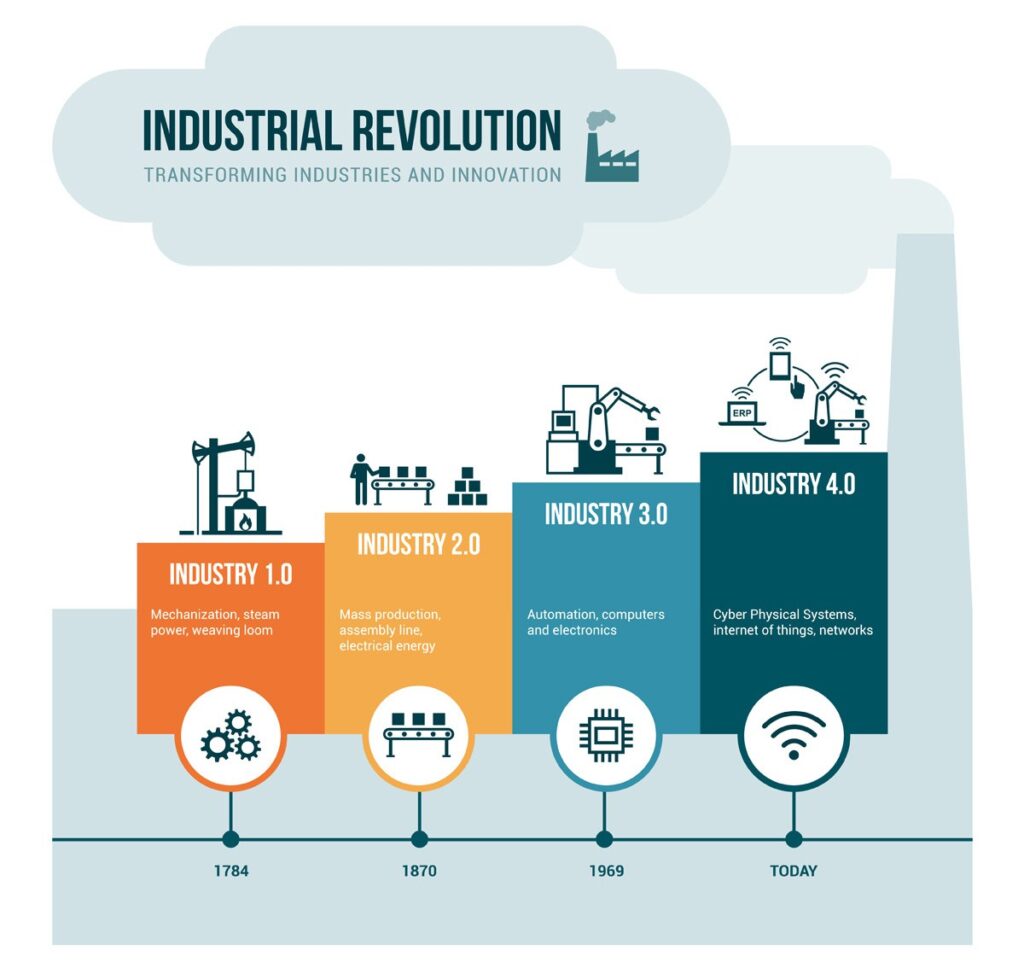
The first three Industrial Revolutions used new technologies to advance the means of production. The First used water and steam power to mechanize production; the Second used electric power to create mass production; the Third used electronics and information technology to automate production. Now, a Fourth Industrial Revolution is building on the Third, the digital revolution that has been occurring since the middle of the last century. It is characterized by a fusion of technologies that is blurring the lines between the physical, digital, and biological spheres.
There are three reasons why today’s transformations are not simply an extension of the Third Industrial Revolution but rather the arrival of a Fourth and distinct one: velocity, scope, and systems impact. The speed of current breakthroughs has no historical precedent. When compared with the previous industrial revolutions, the Fourth is evolving at an exponential rather than a linear pace. Moreover, it is disrupting nearly every industry worldwide. And the breadth and depth of these changes herald the transformation of entire systems of production, management, and governance.

The possibilities of billions of people connected by mobile devices, with unprecedented processing power, storage capacity, and access to knowledge, are unlimited. And these possibilities will be multiplied by emerging technology breakthroughs in fields such as artificial intelligence, robotics, the Internet of Things, autonomous vehicles, 3-D printing, nanotechnology, biotechnology, materials science, energy storage, and quantum computing. The average person will be able to dream of and create things that would have been science fiction a few short years ago.

Aviation 4.0

The Fourth Industrial Revolution means investing in digital solutions and infrastructure and encouraging a cultural makeover for airlines and airports. But this seismic, technology-driven shift also augments the potential for more empathetic relationships between brands and consumers. Companies have never had such access to the brains and feelings of their customers.

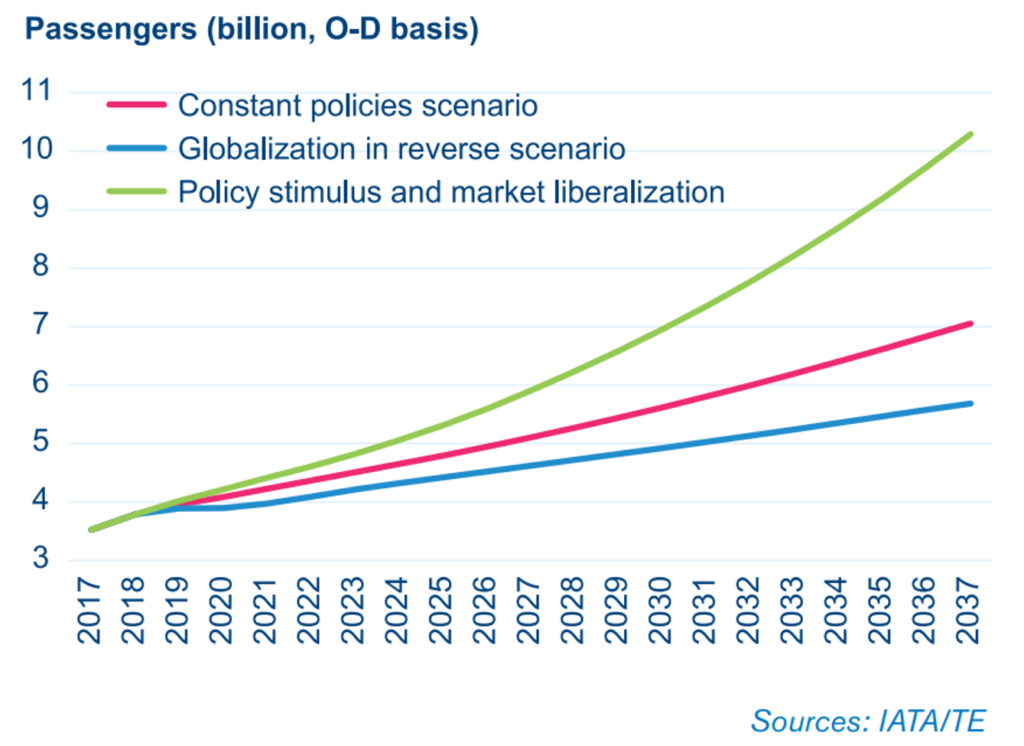
By 2035, there will be 7.2 billion airline travelers annually – almost twice the 3.8 billion in 2016 – according to the International Air Transport Association (IATA)’s forecast. Still, the main question facing the airlines and airports is: what are you going to do to attract these new passengers? Both airlines and airports will have to be creative in leveraging Aviation 4.0 to create new products and services, enhance passenger experience, gain efficiencies and craft an individual niche to ensure that they have the competitive edge.
Airlines have new opportunities to improve service in how consumers book and plan their journeys, enhancing onboard flight experiences, optimizing revenue management opportunities, and predictive maintenance. Airports have the opportunity to leverage Aviation 4.0 by having a 360 degree view of the customer, customizing retail offerings, increasing uptime of critical assets, and enhancing passenger experience by increasing efficiencies at points like check-in, security screening, boarding, and others by the introduction of IOT, artificial intelligence, and Blockchain technology to name a few.
Some other aviation applications of the Industry 4.0 concept are related to the aerospace manufacturing processes. Robotics, additive manufacturing, augmented reality, IoT and simulation are currently applied within the aeronautics manufacturing industry.

Even if there is still a long way to go before the first fully automated airplane is produced, application of a variety of robots at Airbus and Boeing will make monthly production rates above 30 units possible for some aircraft types. A new Airbus spin-off company, InFactory Solutions, is developing the corporation’s vision of the “Factory of the Future,” with products and services for connected manufacturing under a fully connected and digital production environment.

By automating the more mundane processes within the industry, new human-based positions will become available in roles involving strategy and creativity. Within this Fourth Industrial Revolution, the future of aviation is bright, and we will see incredible innovations in our lifetimes.

References

https://www.weforum.org/focus/fourth-industrial-revolution

https://www.weforum.org/agenda/2016/01/the-fourth-industrial-revolution-what-it-means-and-how-to-respond/

https://kambr.media/airlines-and-the-fourth-industrial-revolution

https://www.intechopen.com/books/aircraft-technology/aviation-4-0-more-safety-through-automation-and-digitization

https://www.mckinsey.com/business-functions/operations/our-insights/operations-blog/sparking-the-fourth-industrial-revolution-in-us-manufacturing#

https://www.timesinternational.net/the-4th-industrial-revolution/

http://cresprit.com/en/2018/10/27/in-my-soul-and-absorb-its-power/

https://www.forbes.com/sites/bernardmarr/2018/08/13/the-4th-industrial-revolution-is-here-are-you-ready/#304a4fe5628b

https://www.skyfilabs.com/blog/final-year-projects-on-machine-learning-for-engineering-students

https://spacenews.com/sponsored/industrial-revolution/
Looking at the list of the top 100 global brands for 2019 compiled by The Financial Times, you see the list dominated by technology, retail, fast food, apparel, luxury, alcohol, financial institutions, apparel, personal care, etc. But it’s surprising to see that one key industry that touches everyone’s life is missing, and that is the aviation industry. No airline or airport has made it to the list. Of course, companies like DHL and FedEx are in the list, but they fall within the category of logistics/integrators.
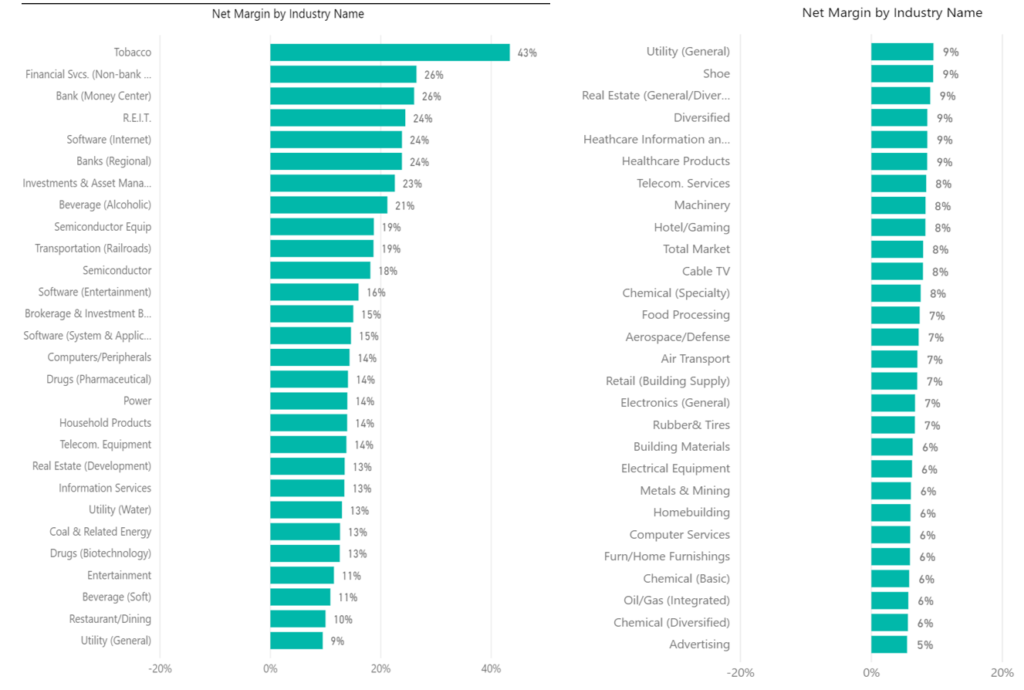
Also, when you look at the profitability margins across 94 industries, one can see that air transportation does not compare to many of the top industries, where it is common to see net margins in the high double digits. Aviation in general struggles to net even 7%.
What the above highlights is that for any company in aviation industry aspiring to be a global brand or fetch healthy double digit margins, they have to do a lot more in terms of reviewing their business models, product and service innovation, brand loyalty, delivering brand promise, creating a niche market, and the list goes on.

However, the intent of this article is not to outline the entire list of components that can bring an aviation organization to the forefront of top brands or earn higher net margins, but to highlight a key skill set without which any aviation organization cannot sustain operations, let alone being a top brand or fetching higher net margins. Having critical thinkers in key roles in the organization is the most important factor to increase profit margins and become recognized as a global brand.

This claim is backed by industry experts: one of the top skills outlined by the World Economic Forum for organizations to be successful in the Fourth Industrial Revolution (the technological revolution) is critical thinking. Let’s first examine what it actually is.

Critical thinking is the ability to think clearly and rationally about what to do or what to believe. It includes the ability to engage in reflective and independent thinking. Someone who can think critically is able to do the following:

Solve problems systematically and identify the relevance and importance of ideas
Understand the logical connections between ideas and interdependencies between various organizational elements
Identify, construct, and evaluate arguments
Detect inconsistencies and common mistakes in reasoning
Critical thinking is not a matter of just accumulating information. A person with a wide breadth of knowledge and a strong memory cannot be termed as critical thinker. A critical thinker is a person who can foresee effects and consequences of actions and decisions and knows how to make use of information to solve key business problems.

Quite frequently, critical thinking is confused with being argumentative or being critical of other people, projects, or initiatives. Although critical thinking skills can be used in exposing fallacies and bad reasoning, critical thinking can also play an important role in cooperative reasoning and constructive tasks. Critical thinking can help aviation organizations by:

·      improving business ideas

·      challenging traditional processes and systems for new improved customer friendly processes

·      assessing realistic market demand

·      enhancing operational efficiencies

·      Innovating and creating new products and services

·      improving employee productivity and organizational culture

·      cutting through the noise and biases

·      and the list goes on

Some people believe that critical thinking hinders creativity because it requires following the rules of logic and rationality, whereas creativity might require breaking rules. This is a misconception. Critical thinking is quite compatible with thinking "out-of-the-box", challenging consensus and pursuing less popular approaches. If anything, critical thinking is an essential part of creativity because we need critical thinking to evaluate and improve our creative ideas.

Once the devastating effects of the COVID-19 pandemic begin to lessen, all organizations within the aviation industry will be facing severe financial challenges. There will be less consumer demand and a more stringent focus on health and safety, which will essentially require critical thinkers in key roles to ensure that decisions are based on due diligence, logical reasoning, data, analytics, and creativity. The best decisions will have to be made to endure and thrive post-pandemic.

References

https://www.ft.com/content/3a3419f4-78b1-11e9-be7d-6d846537acab

https://philosophy.hku.hk/think/critical/ct.php

https://app.powerbi.com/view?r=eyJrIjoiNjY1MGQwNDktY2Y2Ni00ODNiLWI0ZDItYjI0ZWQ2MTg2NjJlIiwidCI6ImVkZmYzMjg1LTk5NGYtNGE1ZC1hNjYxLWRkMTRjMmY1YTU4NSIsImMiOjF9

https://www.weforum.org/agenda/2016/01/the-10-skills-you-need-to-thrive-in-the-fourth-industrial-revolution/