Over recent decades, it has become crucial to develop and refine skills that allow us to understand and act on rapid changes in our environment. The world has become increasingly interconnected and complex, with increased expectations and a lot of unknowns. Design thinking offers a means to grapple with all this change in a human-centric way.

Analytics is an essential component of organizations’ success and is being applied to business and big data to describe, predict, and improve business performance. While there are mature and innovative frameworks for the concepts of business intelligence (BI) and analytics, this article will explore how using a design thinking framework, can enable BI & analytics to contribute more towards creating organization and shareholder value.

First, let’s look at what design thinking is.

Brief Intro to Design Thinking

Design thinking is a design methodology that provides a solution-based approach to solving problems. It’s extremely useful in tackling complex problems that are ill-defined or unknown by understanding the human needs involved, re-framing the problem in human-centric ways, brainstorming many ideas, and adopting a hands-on approach in prototyping and testing.

Design thinking is a process for creative problem-solving that has a human-centered core. It encourages organizations to focus on the publics they serve, which leads to better products, services, and internal processes. When you sit down to create a solution for a business need, the first question should always be: “What's the human need behind it?”

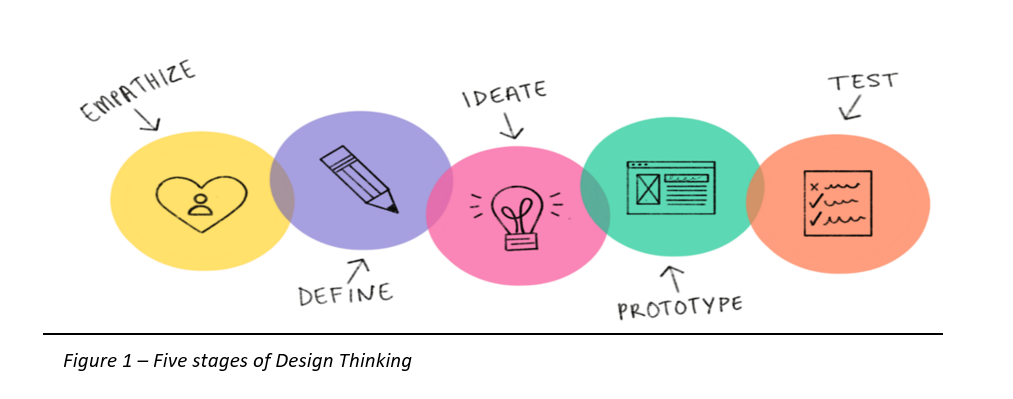
Design thinking revolves around the following five stages.
·      Empathizing: In this stage, you will perform tasks to understand people’s context in reference to the problem. You will gain a new perspective and empathy for who they are, and what is important to them. In order to gain a better understanding of users, you can break the empathy stage into three parts: Observe, Engage, and Watch and Listen.

·      Defining: During the second stage, your goal is to create a succinct definition of the exact problem. You will also create an actionable problem statement using the information and data that was collected in the empathy stage.

·      Ideate: In this stage, you will explore a broad range of possible solutions while keeping the problem statement front-of-mind. By the end of this stage, you should have generated various ideas with a diverse selection of potential solutions.

·      Prototyping: In this stage, you will create a physical representation of your ideas. The goal here should be to test the design of possible solutions to gather inputs without investing too much resources to any of the solutions.

·      Testing: This is the fifth stage, in which you would like to create authentic experiences to test the prototypes. This should not be referred as final stage, as design thinking is an iterative process, and you might need to revisit other stages to refine your solution.

Now that we have touched upon design thinking, lets look at analytics and business intelligence.

Brief Intro to Aviation Analytics

Even though analytics is a common buzzword, the concept itself is an essential component of any successful business. Let’s start with the definition, and the one I like to use is: “Analytics uses statistics, finance, economics, data science, software, and hardware to convert the raw data into insights for businesses to tap into emerging opportunities and mitigating risks.” Analytics is the process of discovering patterns in contextual business data for effective decision-making. It is an iterative process and needs continuous improvement to be refined for best outcomes.
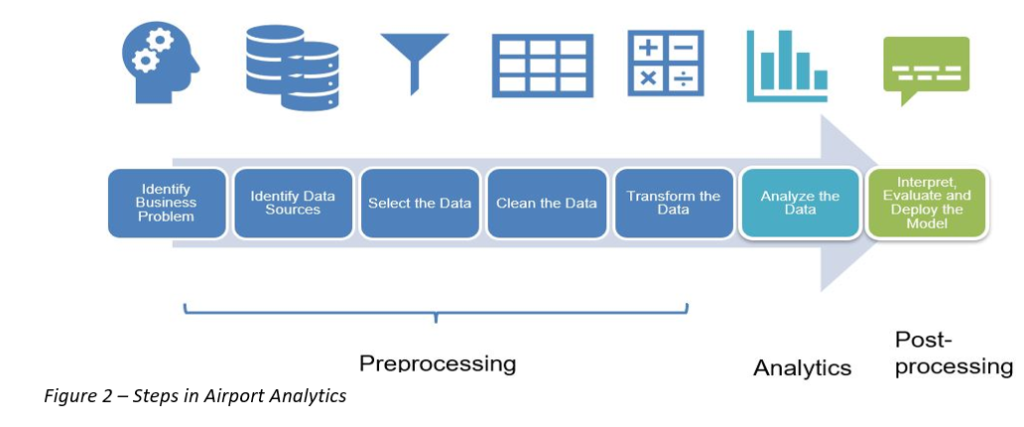
While there are quite a few frameworks for analytics, Figure 2 above shows the crucial steps to follow specifically for aviation analytics.

Any data analytics approach starts with what the business needs are and what kind of problems/opportunities the organization needs to address. This is the most important step and needs to be properly articulated, or else the outcomes will not align with the issue at hand.

Once the business need has been properly identified, you would then identify the relevant data sources and prepare them for analysis. Airlines and airports are rich with data, so identifying which data set is needed is crucial. For example. if you are looking to drive efficiencies in on-time departures or turn-around times, knowing the scheduled and actual time of departure, processing times of various processes, etc. is mandatory.

Once the data has been transformed, it is then ready for analysis to discover any opportunities that might arise, or any challenges the aviation industry might face.

Aviation Analytics through Design Thinking Lenses

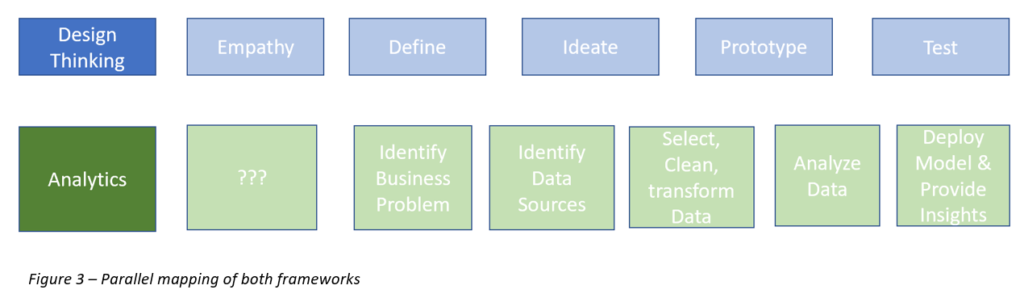
We will start off by mapping both frameworks side by side.
While the define phase in design thinking aligns with identifying business problem in within the analytics framework, and other steps in both frameworks can align in one way or the other, the main differentiator through which analytics can be enhanced is by adding an empathy. While some might argue that this is being done when functional and non-functional requirements are captured in analytics and in other stages of the process, but I would say that the true spirit and essence of empathy is missing from the structure. As highlighted earlier, by adding empathy to analytics, we need to see who the users are, how they interact with data & analytics, what is important to them, and we need to put ourselves in users’ shoes and understand how they will feel about their problems, how will they connect with dashboards and what their experience will be like in order to get deeper insights for the business. The empathy stage can help the analytics team gather insights to human context of how users will be using analytics and will help to define the business problem better.
One other significant similarity between design thinking and aviation analytics is that it is an iterative process which is defined as “an iterative process, or on-going process, is systematic repetition of sequences or formulas that aims to achieve a given result. It is a process where different data is tested until the desired result is obtained.” Both design thinking and analytics uses the iterative process, opting to solve the problem until the time an optimized solution has been achieved.
From my perspective in the aviation industry, integrating a design thinking approach to existing analytics methods would create a more strategic system for everyone involved. The focus on empathy and an iterative process would mean end users are being heard, and the work performed by analytics professionals is valued throughout the organization and industry.
References
https://www.interaction-design.org/literature/article/5-stages-in-the-design-thinking-process
https://www.ideou.com/blogs/inspiration/what-is-design-thinking
https://uxdesign.cc/user-experience-is-design-thinking-2428a0a360c2
Some of us who witnessed 9/11 or the 2008 economic downturn have had almost a decade to forget the traumatic effect a sudden, global recession can have on a company. In a rapidly evolving situation like we’re facing with COVID-19, it becomes very challenging to balance what’s best for your company, protect your employees, and still deliver a great experience to customers amidst the chaos.

COVID-19 is already massively altering humanity and our global economy. There is no doubt that this pandemic will have widespread and long-lasting implications. As cases are recorded globally and recent reports show that nearly a quarter of the world’s population is now under some form of lockdown, an increasing number of companies are facing incredibly worrying times due to supply chain disruptions, diminished customer demand and government-enforced social distancing, among other challenges.

As of today (April 14), COVID-19 has spread to 210 countries/regions with 1,979,853 cases being reported. The spread of the virus has had a deleterious impact on the global airlines industry, and many industry players are now in a serious fight for survival as passenger numbers plunge.

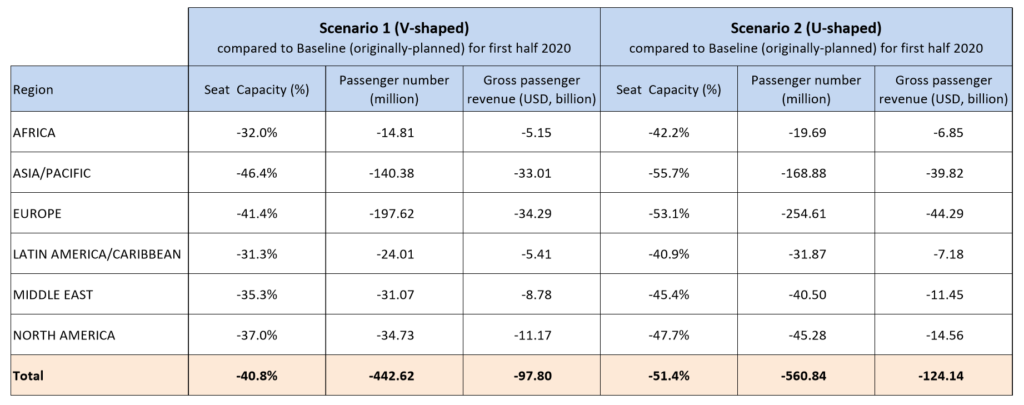
The aviation industry is facing unprecedented challenges due to COVID-19 as it poses a risk to the travelling public because it can be transmitted between humans. There are quite a few forecasts out there, with the following one from ICAO highlighting the impact of COVID-19 on international aviation. Both V and U-shaped scenarios highlight steep declines of 41% and 51% is seat capacity.
While there are other forecasts out there and since the situation is so fluid, I thought it will be worthwhile to focus on key factors that will be instrumental in “how quickly” and “how significantly” passenger traffic will rebound.
1. 100% cure for COVID-19
This is the first and foremost element. Until there is a cure, no one will risk their lives and compromise social distancing, and as a result we won’t see much of the travelling public flying. An industry rebound will not happen unless there is a vaccine and 100% proven cure out there which is available to masses through the normal distribution channels, such as clinics, hospitals, express COVID centres etc. There are a lot of initiatives underway for the vaccine, but a tested, successful one is still not available.
2. Economic Conditions
The coronavirus has had a significant impact on the global economy in the stock market, employment rates, diminishing consumer demand etc. It is quite hard to predict the extent of the economic damage caused by COVID-19, but there is a wider agreement amongst the economist community that it will have severe negative impacts on the global economy. Early estimates predicated that most major economies will lose at least 2.4 percent of the value of their gross domestic product (GDP) over 2020. To give a context to global GDP, global GDP was estimated at around 86.6 trillion U.S. dollars in 2019 – which means that even 1% decline will have a major impact on economic output. Since these projections were made, a lot has changed with widespread restrictions on social contact to stop the spread of the virus, travel restrictions, etc. Global stock markets have suffered dramatic falls due to the outbreak, and the Dow Jones reported its largest-ever single day fall of almost 3,000 points on March 16, 2020 – beating its previous record of 2,300 points that was set only four days earlier.
The economic challenges caused by COVID-19 have raised unemployment rates globally with just the United States registering in the last two weeks in March almost 10 million people applied for unemployment benefits. Such a sharp and staggering increase has never been seen before, not even at the peak of the global financial crisis in 2009.
The economic challenges and high unemployment rates will deter people from taking leisure trips and cause organizations to cut their corporate travel budget to retain the financial viability of their organization, and this might delay the passenger demand.
3. Government Support
As global aviation and tourism sectors face a decline of epic proportions because of the COVID-19 pandemic, government support during this period will be crucial. Various governments are planning or have extended aid packages to save the industry, and this includes extending support to airlines, airports and other stakeholders. The response from governments around the world varies greatly, some of which are highlighted below:
· The British Government has told airlines not to look to the government and to find other means of financial support. Government would enter negotiations with airlines only after they had exhausted all other means of support.
· Australia announced an A$715 million (US$430 million) aid package comprising refunds and forward waivers on fuel taxes, domestic air navigation and regional aviation security charges.
· Brazil is allowing airlines to postpone payments of air navigation and airport fees.
· China has introduced a number of measures, including reductions in landing, parking and air navigation charges as well as subsidies for airlines that continued to mount flights to the country.
· New Zealand’s government will open a NZ$900 million (US$580 million) loan facility to the national carrier as well as an additional NZ$600 million relief package for the aviation sector.
· Norway’s government is providing a conditional state loan-guarantee for its aviation industry totaling US$533 million.
· US Government aid package includes $32 billion in grants for the airline industry. A further $25 billion will be available in the form of loans or loan guarantees for passenger airlines and $4 billion for cargo airlines. The package also includes $3 billion to pay airline and airport contractors and $10 billion for airports.
· Canadian Government is waiving ground lease rents from March 2020 through December 2020 for the 21 airport authorities that pay rent to the federal government which amounts to CAD$331.4 million.
4. Digital Adaption
Already, 70% of companies had a digital transformation in place or were working on one, but it seems most companies were not far enough along to make COVID-19 a non-issue. There are a few reasons why the Coronavirus, or COVID-19 have forced companies to visit a digital transformation faster. It’s essential that enterprises build in the necessary operational resilience to survive this new reality. This pandemic has showcased the value of data & digital transformation, and organizations should use this time to accelerate the transition. Even when the COVID-19 outbreak is contained, it’s unlikely things will return to normal. Instead, there will be a faster adaption to the slow pacing trends we have being seeing till now and are likely to shape the future for the long haul.
Many people in industries - that formerly prohibited it - are now working from home. Bankers, teachers, engineers, accountants, sales professionals etc. - work-life has changed for most of us. We are telecommuting with our colleagues and spending time with friends and family on video calls as well, in order to not completely get isolated.
This mass adoption of telecommuting is the most explosive change to occur as a result of the COVID-19 outbreak. While remote work is more normal now than it was a decade ago, a recent survey found that 49% of workers never worked from home. Whatever objections businesses have previously had to telecommuting, COVID-19 may be the moment that brings it into the mainstream and shows leaders that with the right technology, culture, and expectations, employees can be just as productive and effective from home.
If the current situation persists for 6-9 months and as companies adapt telecommuting into their business models, this will have major impact on corporate travel, as businesses will have gotten used to using online platforms for sales calls, product demonstrations, and boards meetings, and coming out of this pandemic companies will have tight budgets with less amounts for travel.
5. Social Impact
We are facing a global health crisis unlike anything in the 75-year history of the United Nations — one that is killing people, spreading human suffering, and upending people’s lives. But this is much more than a health crisis. It is a human, economic and social crisis. The coronavirus disease (COVID-19), which has been characterized as a pandemic by the World Health Organization (WHO), is attacking societies at their core. The COVID-19 pandemic is testing societies in various ways; for example, in some regions of the world, many depend on informal work for their livelihood. Physical distancing measures directly affect their livelihoods and make immediate social assistance imperative.
The COVID-19 outbreak affects all segments of the population and is particularly detrimental to members of social groups in the most vulnerable situations, continues to affect populations, including people living in poverty situations, older persons, persons with disabilities, youth etc. If not properly addressed through policy, the social crisis created by the COVID-19 pandemic may also increase inequality, exclusion, discrimination, and global unemployment in the medium and long term.
As emphasized by the United Nations’ Secretary-General, during the launch of a COVID-19 Global Humanitarian Response Plan on March 23, 2020: “We must come to the aid of the ultra-vulnerable – millions upon millions of people who are least able to protect themselves. This is a matter of basic human solidarity. It is also crucial for combating the virus. This is the moment to step up for the vulnerable.”
Conclusion
COVID-19 is an unprecedented event with catastrophic impacts on all walks of life, and that’s why the traditional way of business planning, forecasting, or financial planning will not be effective to determine how quickly and to what extent the aviation industry is going to rebound. The industry needs to look at the five lenses presented above as triggers to get better insights how to align their business model for the post-COVID environment. No one right now knows how long this pandemic is going to last, but one thing we have seen from history is that the aviation industry is resilient to global phenomena and always comes out stronger than before from global crisis.
References
https://www.icao.int/sustainability/Documents/COVID-19/ICAO_Coronavirus_Econ_Impact.pdf
https://blogs.imf.org/2020/04/06/an-early-view-of-the-economic-impact-of-the-pandemic-in-5-charts/
https://www.oecd.org/coronavirus/en/
https://www.giga-hamburg.de/en/publication/assessing-the-political-and-social-impact-of-the-covid-19-crisis-in-latin-america
Introduction and Definitions

Organizations’ successes and failures can traditionally be attributed to any of the following: not adopting technology, inefficiencies, high costs, not being innovative, econometric impacts, and the list goes on and on. No one realizes that these are just elements of a mosaic, and for a business to effectively compete and grow, the business model must make sense and should be well thought out. In this article, I will explore at a higher level what a business model is and then provide an overview of its applications in aviation, especially airlines and airports (further referred to as “A&A”).

To begin, let’s narrow down what a business model is. There are various definitions, and some are:

Magretta defines business models in terms of value chains: “Part one includes all the activities associated with making something: designing it, purchasing raw materials, manufacturing, and so on. Part two includes all the activities associated with selling something: finding and reaching customers, transacting a sale, distributing the product, or delivering the service. A new business model may turn on designing a new product for an unmet need or on a process innovation. That is, it may be new in either end.”

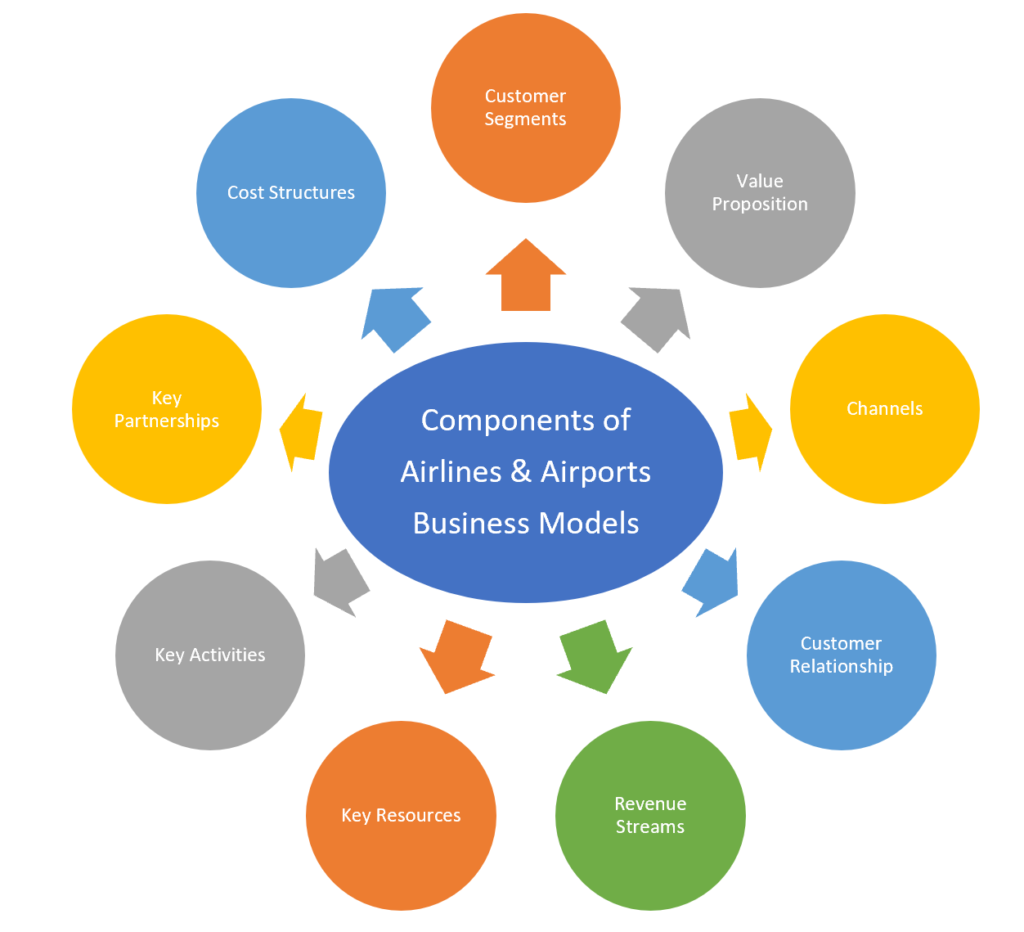
Alex Osterwalder defines it as: “A business model is really a set of assumptions or hypotheses, and is essentially an organised way to lay out your assumptions about not only the key resources and key activities of your value chain, but also your value proposition, customer relationships, channels, customer segments, cost structures, and revenue streams — to see if you’ve missed anything important and to compare your model to others”.

Business models are also often confused with strategies when comparing one model to another. To put it simply, a business model is a description and framework of how the business runs, and a competitive strategy is how you will out compete your competitors. A sound business model answers simple questions with clarity as to who the customers are, what they value, how the firm delivers this value, and how the firm differentiates itself from competitors when delivering value in terms of processes, products, services, efficiencies, and pricing.

The Rise of Disruption

A business model is like a mosaic in that you cannot look at individual sets but have to look at the total picture to understand what it’s trying to say. Start-ups and new market entrants are coming up with better business models, which are forcing the traditional firms to start thinking differently or risk losing market share to the point of closing the shutter. The point of disruption doesn’t appear overnight to businesses; instead, they start getting red flags quite early on. Initial symptoms such as high expense initiatives leading to little or no revenues, smaller improvements to core processes, less innovative ideas from inside the organisation, greater reliance on inputs for strategy and product offerings from external sources. These are just some of the indications which businesses should always be on alert for.

Business models for A&A may differ due to region, industry environment and structure, competitive environment, ownership structure, etc. In any case, the business must be clear and crisp of what its business model is. While there are various frameworks and structures that can help define a business model, here we will use Osterwalder’s nine building blocks to define airline and airport business models, as these are quite similar regardless of the type of ownership structure or region. The nine components are illustrated below:
Customer Segments

               Customers are the reason why A&A are there, so they are the centre of the business model. To better serve their customers, airlines and airports would group customers into specific segments to better cater to their needs. Some of the customers for airlines are first-, business-, or economy-class passengers; and for a hub or non-hub airport, customers include airlines, passengers, cargo operators, tenants, and real estate developers. Airlines and Airports then have to make a decision as to which segment they are going to target. Once a decision has been made, the business model would then have to be designed and developed around the customer’s needs. Some of the different types of customer segments are:

·        Mass market

·        Niche market

·        Segmented

·        Diversified

·        Multi sided platforms

Value Propositions

The value proposition describes the products and services that the airline and/or airport are going to offer to the target business segment. This is what creates a niche and why customers will choose one airline or airport over another. Some important things to consider when designing value propositions are:

·        Which customers are we going to target?

·        What are their needs?

·        What value (products and services) are we going to deliver to them?

·        What percentage of customer needs are we going to satisfy through our value proposition?

 Values can be quantitative (price, speed of service) or qualitative (design, customer experience).

Channels

Channels that needs to be considered for interface with the customer are communication channels, sales channels, and distribution channels. Usually channels are the customer touch points and account for customer experience. Channels serve function such as:

·        Raising awareness amongst customers regarding company’s products and services

·        Helping customers compare value propositions

·        Allowing customers to purchase specific products and services

Some important questions to ask are:

·        Through which channels do our customer segments want to be reached

·        How are we reaching them now?

·        How are our channels integrated?

·        Which ones works best?

·        Which ones are most cost-efficient?

Channels have five phases:

·        Awareness: How do we raise awareness?

·        Evaluate: How do we help customers evaluate our value proposition compared to competitors?

·        Purchase: How do we allow customers to purchase our products?

·        Delivery: How do we deliver value proposition?

·        After sales: How do we provide post-purchase service?

Customer Relations

Customer relations are established and maintained with each customer segment. The main intents for building customer relationships are:

·        Customer acquisition

·        Customer retention

·        Boosting sales (up-selling)

In the beginning days of mobile technology, organisations were first focusing towards customer acquisition and then as market saturated, they started placing more focus on customer retention. One should consider the following:

·        What type of relationships do each of the customers expects from us?

·        Which ones have we established?

·        How costly are they?

·        How are they integrated with the rest of our business model?

Some of the categories of business relationships are:

·        Personal assistance: Through call centres or by email

·        Dedicated personal assistance: Personal bankers for high net worth individuals

·        Self-service: no direct relationship with the customer

·        Automated services: personal online profiles giving access to customised services

·        Communities: User communities to know more about their customers and solving those

·        Co-create: Getting customers

·        To create content and add value for example, Youtube

Revenue streams:

If customers are the heart of the business model, then revenue stream are its arteries. A successful business knows the price its customers are willing to pay for the value they get in return. How they are currently paying, how they would prefer to pay, how much each revenue stream contributes to overall revenues.

For airlines, the revenue streams are from passenger ticket sales, cargo carriage, and ancillary revenues from baggage, on-board sales, etc.

Typical revenue streams for airports are aeronautical revenue, which includes revenue like aircraft landing and parking and other related aeronautical activity; non-aeronautical revenue such as concessions, car parking, etc.; and non-aviation related revenue which may include real estate development, etc.

Basically, at a high level there are two types of pricing mechanisms: either a fixed menu pricing or a dynamic pricing. While airlines have introduced dynamic pricing in fares, airports are still pretty stagnant in the fixed pricing structure.

Key Resources

Key resources allow airlines and airports to create and offer value propositions, reach markets, maintain relationships with customer segments, and earn revenues. Key resources can be physical, financial, intellectual, or human resources.

Key resources for an airline are aircraft, ground support equipment, reservation and distribution systems, maintenance and repair overhaul facilities, etc.

Key resources for an airport to name a few are runways, terminal buildings, intellectual property rights, process efficiencies designs, cash and line of credit.

Key Activities

These are the most important activities an airline or an airport must undertake to operate successfully and be profitable. Just like key resources, these activities create value propositions. For PC manufacturers like Dell, key activities include supply chain management; for consultancy groups like McKinsey, key activities include problem solving.

Key activities for an airline are the transportation of passengers and cargo from point A to point B and depending upon various airports business models, key activities include keeping capacity ahead of demand and delivering efficient services at each customer touch point.

Key Partnerships

These include suppliers and partners that makes a business model work. Three main reasons airlines and airports may enter into partnerships are optimisation and economy of scale, reduction of risk and uncertainty, and acquisition of particular resources or activities, for example ground handling companies.

Cost Structures

Cost structures includes all OPEX and CAPEX costs that are required to run the business. While cost is always an important element some companies are either cost-driven- or value-driven. Value-driven airlines are full-service carriers, and cost-driven are no-frills low-cost airlines. In the airport environment, the majority of the mega hubs are value/efficiency-driven, while spoke airports are cost-driven.

The above are nine key elements of A&A business models. Successful and forward-looking organisations have to ensure that they are aligning their strategies and aspirations to the business model, as any gaps will result in less than desirable results.

References

1.      What is a business model. https://hbr.org/2015/01/what-is-a-business-model

2.      When your business model is in trouble. https://hbr.org/2011/01/when-your-business-model-is-in-trouble

3.      Oasterwalder & Pigneur (2010). Business Model Generation.

4.      http://www.bmnow.com/business-model-innovation/
The environment and industry in which any firm operates is a crucial element in determining the market’s attractiveness in terms of present and future demand, ease of doing business, as well as the level of competition. In this sense, it is the environment and industry in which the firm operates that will in turn influence and determine its strategy in terms of the market segments to serve, services and products to offer, activities such as  production, marketing, sales, and post-sales service, and the most effective method to do it.

Within a firm’s value chain, the term “value” is used to indicate that it is the set of activities mentioned above that deliver some useful good or service to customers at a price that they are willing to pay, given the perceived or actual benefit of this good or service. And then this value must be delivered in a most cost-effective way to ensure profitability.

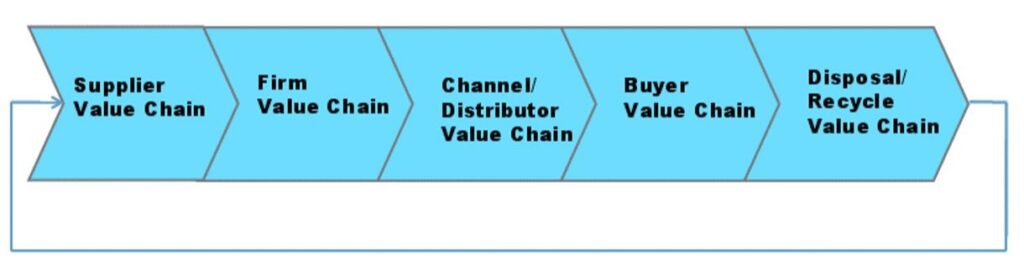
This larger environment in which the firm is seen to operate is many times termed as the ‘value system’ which essentially is the ‘industry value chain’ as against the firm’s “value chain.” The firm value chain becomes a part of the larger industry value chain as per following figure.
The Value Chain within the Air Transportation Industry

In this article, we will explore the value chain for the air transportation industry and how all the players (11 key players) in the chain create value for customers, their competitiveness and profit margins. The following diagram gives a snapshot of all the key players in the industry value chain.

1. Aircraft Manufacturers

This segment in the value chain is rich in knowledge, research and development along with engine and component manufacturing. The launch of a new aircraft platform is a huge financial undertaking. To put this in perspective the design, certification, and production cycle for the Boeing 787 cost approximately $32 Billion USD. This outpaces development of any other product and is not within the scope of regular investors. Currently Boeing and Airbus have a duopoly in the industry and have been recording an average of 11% profit margins in the past few years.

2. Engine Manufacturers

This segment shares many similarities with the previous segment. Each project is a huge undertaking and has associated risks, but they have to be carried out to keep the company at the leading edge of the curve. There are three dominant players in this market: Pratt & Whitney, Rolls Royce, and General Electric. The average profit margins are above 20% in this sector

3. Component Manufacturers

Components in the aircraft are all designed to perform a specific job, such as, avionics, breaks, wheels, navigational computers, electrical generators, etc. There are various players in each area of component manufacturing, but as an example if we look at avionics, which is one of the most critical and expensive areas, we will find three main players: Honeywell, Rockwell Collins, and Thales. These players’ average profit margins are above 15%.

4. Lessors

Airlines have typically two options: either buy an aircraft or lease it. When leasing, airlines can dry lease, which involves renting the aircraft from a lessor and taking care of maintenance and other activities involved in the operations of the aircraft. This is quite a capital-intensive undertaking, so the dominant players are AerCap and GECAS. AerCap has a portfolio of more then $31 billion in aircraft and net profits of above 20%.

5. Maintenance, Repair and Overhaul (MRO)

This segment of the value chain is crowded with players. Initially, airlines used to undertake their own maintenance activities, but the recent trend has been to outsource so that airlines can focus on their core business. Even with this there are certain areas of maintenance that airlines still keep in-house. Profit margins in the MRO sector are typically between 5-10%.

6. Air Navigation Service (ANS) Providers

Air navigation services are usually provided by state-owned entities and in some cases private entities. Each country provides ANS by employing radars, air traffic control facilities, and skilled professionals to provide safe passage to flights. ANS charges for the consumer are considered levies or fees, as they are not based on market rules but rather the political and economical situation of each country.

7. Airports

Airport ownership is quite varied around the world, with some owned by states, or local municipalities, or by private institutions. Airports by design are a natural monopoly. That is to say, if an airline plans to serve a city, generally it has no other choice than to use the nearest airport that offers all the required infrastructure and facilities. Earlier in history, the main pillars for airport revenue were aeronautical charges, but most forward-looking airports are looking at non-aeronautical and non-aviation revenue streams. Airport profit margins are between 20-40%, even though there are various regulations that might impact the profitability of the airport.

8. Handling Companies

Handling companies take care of the aircraft, checking-in and boarding of the passengers, loading and off-loading of cargo and baggage, cleaning of aircraft and cabins, and more. The handling companies are both labour- and capital-intensive and because they need authorisation from airport to operate, entrance cost is a major factor for them. Average handling companies’ profit margins are from 10-11%.

9. Fuel Companies

This segment is pretty much oligopolistic in nature and is in line with the competitive landscape of handling companies. These also need authorisations from the airport to operate and their profit margins are between 10-11%.

10. Travel Agencies and Global Distribution System Providers

Just like any other industry, distribution is key for suppliers to sell their products. Travel agencies, due to the explosion of internet sales, have adapted their business model to offer bundled products and services, travel experiences etc. online sales portals like Expedia, Opodo, and others have been quite successful, and their margins have been in the range of 12%. The GDS segment has been consolidating for some time and the sector has a duopoly with Sabre and Amadeus, and the margins are in the range of 20-30%.

11. Airlines

Airlines are the most critical segment to the whole air transportation value chain. Airlines are the starting point, driver, and enabler of this whole economic cycle. Unfortunately, when you look at the past 10 years of airline margins, they are a meager 2%.

The following graph depicts the profits margins for each player in the value chain. The airlines are the only group that falls below the average profit margin line
Overall, the profit margins in the air transportation value chain are very impressive. As previously mentioned, it is unfortunate that airlines see such a small return on investment. Further investigation could be conducted on increasing the profit margin for this important player.

References

Loddo, A. (2018). Airline Management - A Different View.

Rajagopalan, G. (2015, November 17). Industry Value Chain: Understand its Importance and Application to the Mining Industry. Retrieved from http://flevy.com/blog/industry-value-chain-understand-its-importance-and-application-to-the-mining-industry/
Aviation is a highly competitive industry, and with lower margins then other industries, airports need to ensure that they have a competitive niche and are transforming their businesses to keep up with changing tides. Approximately 70% of the world’s airports lose money, which clearly highlights the need for the effective and efficient use of data and analytics.

As W. Edwards Deming says, “In God we trust, all others must bring data”. Airports create and use massive amounts of data and must ensure that they are properly analyzing this data to ensure that their decision making is informed, and that they are using every bit of intelligence available to create organizational value. Airports can create organizational value in three ways:

1) enhancing and diversifying revenues

2) optimized use of assets, such as runways, check-in counters, gates, slots, etc.

3) creating efficiencies: Minimum connecting time, higher employee ratio to passengers/revenues, etc.

In this article, we will explore what airport analytics is, how it can help the airport business transform, what resources are needed for setting up a lean and effective analytics department, examples of analytics in airport environment and finally end with some key trends in analytics for 2020.

What exactly is airport analytics?

While analytics is a common buzzword, the concept itself is an essential component of any successful business. Let’s start with the definition, and the one I like to use is: “Analytics uses statistics, finance, economics, data science, software, and hardware to convert the raw data into insights for businesses to tap into emerging opportunities and mitigating risks”. Analytics is the process of discovering patterns in contextual business data for effective decision-making. It is an iterative process and needs continuous improvement to be refined for best outcomes.

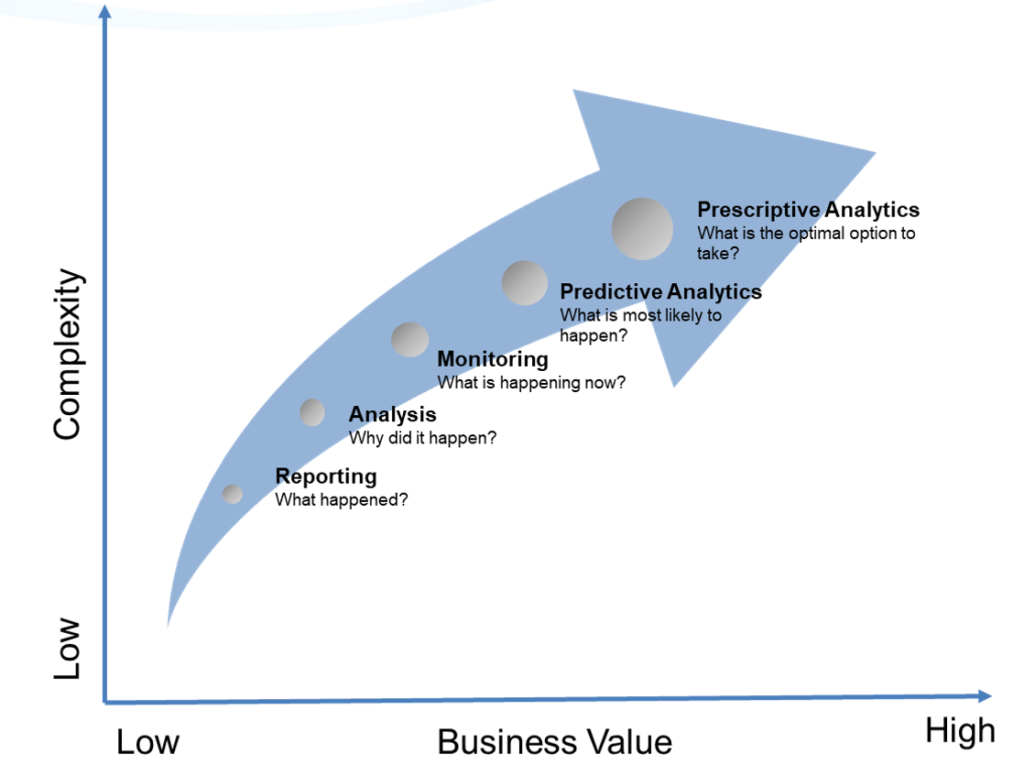
Each airport at any given time falls within the following matrix of maturity. One key thing to note is that as airports climb up the ladder of maturity it becomes more complex, but the rewards are even greater in terms of business value.
While there are quite a few frameworks for analytics, Figure 2 above shows the crucial steps to follow for airport analytics.

Any data analytics approach starts with what the business needs are and what kind of problems/opportunities the airport needs to address. This is the most important step and needs to be properly articulated, or else the outcomes will not align with the issue at hand.

Once the business need has been properly identified, you would then move towards identifying the relevant data sources and preparing them for analysis. Airports are rich with data, so identifying which data set is needed is crucial. For example. if you are looking to drive efficiencies in on-time departures or turn-around times, knowing the scheduled and actual time of departure, processing times of various processes, etc. is mandatory.

Once the data has been transformed, it is then ready for analysis to look at insights for opportunities that might arise, or any challenges airport might face. I would also like to debunk some common myths that I see quite often in the industry.

Some Myths about Analytics

Your airport isn’t big enough to need analytics

Airport size is irrelevant. You can use two basic data sets like passenger numbers and seat capacity, mesh it with your finance data and do ASD analysis, capacity and financial analysis, etc.

2. Great insights sell themselves

Great insights are strong and have a lot of traction, but sometimes pose challenges to traditional way of doing things. In instances like these, a proper change management plan and data storytelling greatly helps.

3. We have a lot of data, and that’s good

Having a lot of data should not be the goal, but having relevant data is the key. Analysts then needs to apply various models and techniques to have meaningful insights for airports for optimized decision-making.

4. Analytics won’t tell you anything you don’t already know

The world changes over time; what may have been true ten years, five years, or even a few months ago may no longer hold true. A true data culture employs the scientific method and always tests what we think we know to see if it still holds true. Through this process, new insights are gained, and strategies and tactics can be adjusted much faster to ensure desired outcomes are achieved.

5. Reporting = analytics

Reporting is the process of organizing data into informational summaries in order to monitor how different areas of a business are performing, Analytics is the process of exploring data and reports in order to extract meaningful insights, which can be used to better understand and improve business performance. Both are important, but distinct, functions.

6. Analytics is an IT function

This myth stems from confusing reporting with analytics. Reporting in old legacy systems was/is very much dependent on IT and IT skill sets. Analytics is focused on working with data to provide insights that help drive business decisions and outcomes. Modern tools allow for analysts to perform this function with a limited knowledge of query languages and more emphasis is placed on math, data and business knowledge. Modern organizations have developed analytics as a stand-alone function, often under a Chief Analytics Officer (CAO) in larger organizations.

How can analytics help airports transform?

Airports around the world are revisiting their current business models and/or exploring ways how they can disrupt the industry, but the approaches they are using are quite traditional, such as: non-hubs trying to be hubs, becoming an Aerotropolis, increasing non-aeronautical revenue, developing air services, and the list goes on. By no means am I saying that these approaches don’t have merit; these are solid business tactics that give a pretty good return on investment to the airports. The issue is that almost all airports are targeting the same business segments without looking into what the customer wants, how the markets are changing, is the business sustainable, etc., and that’s where analytics comes in and can help the airports target the right business opportunity, identify areas of optimization and new revenue streams to reinvent the business model, and also to enhance passenger experiences to what passengers really want, rather then what stakeholders want it to be.

Below are some of the examples of key areas where analytics can help airports be at the leading edge of the curve and have a focused approach to what needs to be changed, what is valued by customers, avoid duplication of resources, have a competitive edge, and disrupt the industry before they get disrupted by it.
Required resources for setting up a lean and effective analytics department

A successful data analytics program requires several ingredients and calls for a comprehensive skill set in analytics, business, and technical areas. Data analytics touches many functions, groups, and people in organizations. Its application may begin as an experiment, but as it evolves it can have a profound impact across the organization, its customers, its partners, and even its business model. A successful big data analytics program requires many interacting elements. It requires, of course, data, which must be integrated from many sources, different types of analysis and skills to generate insights, and active stakeholders who need to collaborate effectively to act on insights generated.

The following resources are needed for setting up a bare minimum analytics department:

·      Human Resources: Data Scientist and a Business Intelligence Developer

·      Infrastructure: Data Repository

·      Tools & Applications: ETL tools and a data visualization tool

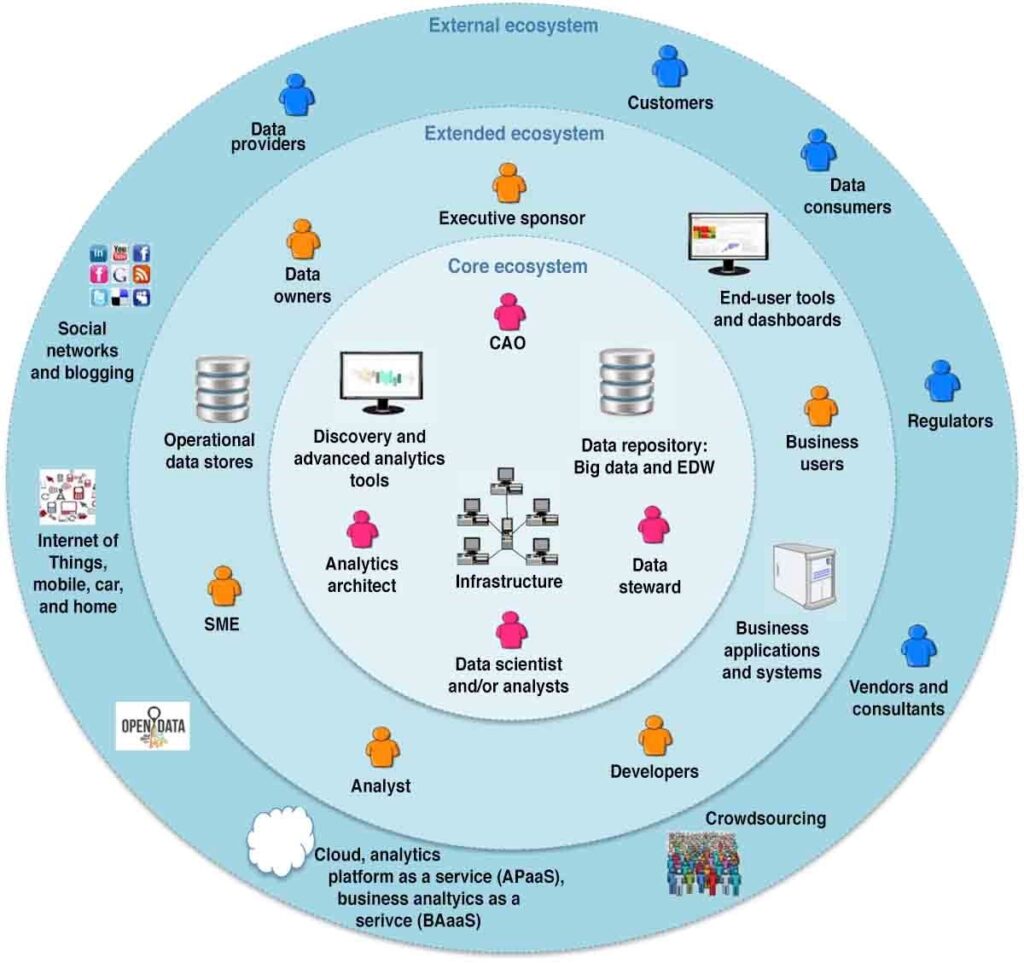
More sophisticated airports need to look at the whole analytics ecosystem, which contains individuals and groups — business and technical teams with multiple skillsets, business partners and customers, internal and external data, tools, software, and infrastructure. A thriving data analytics ecosystem facilitates collaboration among core, extended, and external ecosystems.
In the Core ecosystem, individuals and technologies assemble the data that is required, analyze the data to generate insights, and determine actions based on these insights to achieve business outcomes. In the Extended ecosystem, individuals, groups, and systems direct the analytics projects, collaborate with the core team, provide raw data, consume the outputs, and act on the insights. And in the external ecosystem, customers, business partners, vendors, data providers, and consumers interact with the organization to help deliver the full potential of big data goals.

Examples of analytics in airport environment

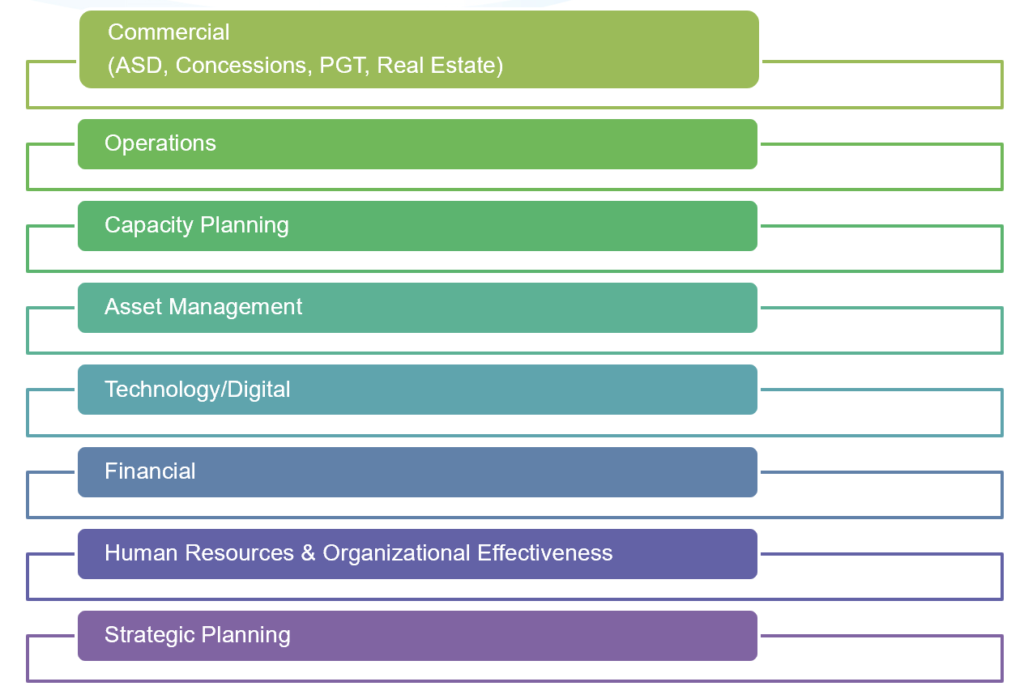
While analytics is an overarching framework for realizing business value, the areas mentioned below (e.g. air services development, operations, and capacity planning) absolutely need strong analytics to be performed, as those relate to core activities and business model for the airports
Key analytics trends for 2020

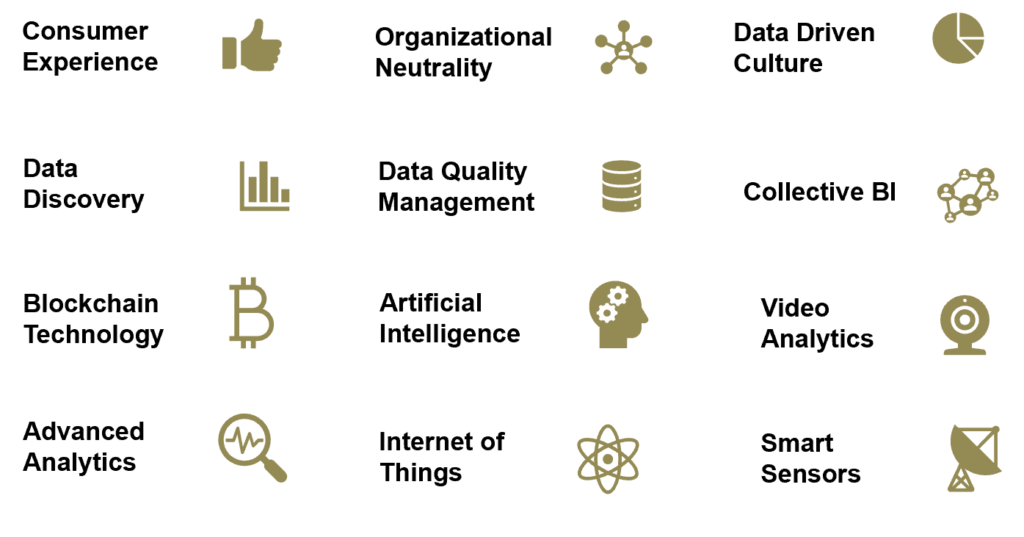
Over the past decade, the field of analytics has been greatly revolutionized. Data has exploded and became big and is increasing at high volume at every given second. Spreadsheets finally took a backseat to actionable and insightful data visualizations and interactive dashboards. The rise of self-service analytics has democratized the data product chain and as a result, advanced analytics is not only for analysts anymore, but the power has been transferred to business users. 2020 will see major advancements in analytics and some key trends that will be visible across airports and other industries are illustrated in the following graphic.
I won’t go through all these, but I will touch upon some important ones. Consumer experience is one that should be top of mind for all analytics projects. This includes how the user interacts with the analyses, either through a data visualization tool or just navigating through the dashboards. This also yields to higher engagement with business users and promotes a data driven culture. The next one I would like to touch upon is the collective BI. Gone are the days in which you can do analysis while being siloed. For any effective BI/analytics program, one has to work cross-functionally with all business areas, IT, and other stakeholders to ensure that one has the holistic picture of the business and the industry.  The last one I would like to touch upon is the organizational neutrality. You have to empower all the users with trusted, clean and ready-to-use data rather then restricting information. Also, one has to ensure that BI/analytics are free of influence from any business area and that’s why forward-looking businesses have increased analytics position to a C-suite position as Chief Analytics Officer.

References

http://www.airport-world.com/features/economics/2691-airport-profitability.html

https://www.datapine.com/blog/business-intelligence-trends/
We are living in an era of disruption in which new business models are changing the way value is created and delivered. The Aviation industry, and Airports, are not immune to disruption and to be at the leading edge of the curve must consider non-traditional approaches toward Air Service Development, non-aeronautical sources of revenue and non-aviation development.

An effective strategy can help Airports carve a competitive edge and effectively compete against Hub and non-Hub Airports within their competitive canvas.

Airport Strategy Defined

Strategy is simply defined as a high-level plan for achieving Airport goals with available resources. Strategic Planning is the process of defining the strategy, direction or path the Airport wants to take and allocating its resources to achieve its goals.

An effective Strategic Plan is crucial to an Airports success because it provides a sense of direction and outlines measurable goals. Strategic Planning is a useful tool for guiding day-to-day decisions and evaluating progress and changing approaches when moving forward. In order to have the best results, an Airport should give careful thought to strategic objectives and then back up these goals with realistic, thoroughly researched, quantifiable benchmarks for evaluating results.

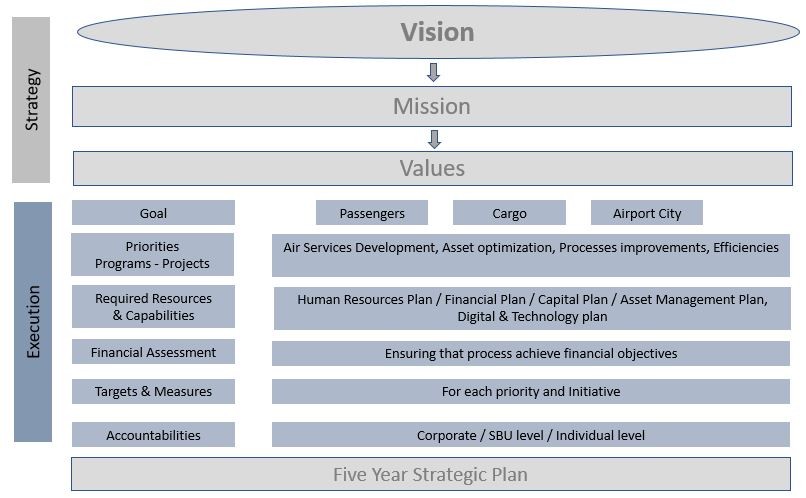
While there are dozens of frameworks out there, I have tried to put together a simple and practical framework that can help in aligning an Airports Vision to its Goals, all the way through to identifying individuals’ accountabilities in contributing to the Vision. Airports need to show employees how each team member is crucial to achieving the Vision, irrespective of which department they work in.

Strategic frameworks should be simple, practical and well articulated

The overall framework can be divided into two parts: Strategy and Execution. The first part is strategic in nature where the Airport goes through a structured process to define a Vision, Mission, and Values for the Airport. The most important of these is Vision as this gives the Airport a clear, comprehensive “photograph” for the future. It provides direction because it describes what characteristics the Airport needs in order to be successful in the future.
A Vision describes WHAT you are trying to achieve in the future. It is the end result of a Strategic Planning process. Some compelling Airport Visions are:

·        Singapore Changi Airport: Exceptional people. Connecting Lives

·        Dubai Airports: To always go further and be the world’s leading airport company/

·        Adelaide Airport: To be a top tier Airport Business in Asia Pacific, recognised for delivering exceptional outcomes to our customers, partners, shareholders and community.

·        Edmonton International Airport: More flights to more places

The second and most crucial part is the Execution of the Strategic Plan as without proper Execution even the best and most thoughtful Vision and Mission will not bring any tangible value to the Airport.

The right Execution starts with setting up tangible and realistic goals in terms of Passengers, Cargo or Aerotropolis/Airport City growth rates. This is also the starting point in which a demand forecast is done based on econometric indicators and incremental growth initiatives taken by the Airport.

Based on the demand forecast an Airport then needs to setup its priorities for Air Service Development as to which regions and carriers to target, required peak hour capacity to handle the throughput and passenger experience that needs to be delivered. This is an important phase as an Airport might have quite a lot of opportunities, but this is where an airport has to focus on what is required and not required to achieve its goals. At this stage an Airport might adopt various priorities models to help them sequence out the projects and see what gives the best return on investments.

Once the priorities are set, then at an enterprise level an Airport has to evaluate what resources are needed in terms of Capital, Technology, Human Resources etc. One important thing to remember is that Airports should look at the Total Cost of Operations (TCO) rather then just looking at one cost component as this is the foundational element for financial assessment.

Airports need to assess the whole Strategic Plan through financial assessment to ensure that the plan is financially viable. An Airport might evaluate the plan to ensure that certain Key Performance Indicators (KPI’s) like EBITDA, Net profit, etc. are met.

Once the Strategic Plan has met the financial thresholds, a Scorecard should be created to list the Targets and Measures. The Scorecard acts as a monitoring mechanism for progress and to see if any changes are needed in the plan.

Lastly, the Airport must set up accountabilities at the Department and Individual level. This is the last and most important step as it’s people who are going to accomplish the Airports Vision and take it to the next step.

To summarise, this simple yet practical Strategic Planning process can help Airports navigate through this era of disruption and carve a competitive edge in becoming one of the world’s leading Airports.

I hope this article was helpful. Feel free to contact me if you have any queries or want to discuss further on this.

References

https://yourbusiness.azcentral.com/strategic-planning-important-organization-4103.html

https://changedesignsportal.worldsecuresystems.com/public/organisation/org_strategy/What-are-vision-and-values.html

http://www.changiairport.com/corporate/about-us/our-belief.html

https://www.adelaideairport.com.au/corporate/about-us/company-profile/vision-mission-values/

http://corporate.flyeia.com/node/10413
We all love new ideas, new business models, buzz words and new technologies and one that is getting a lot of attention is Blockchain technology.

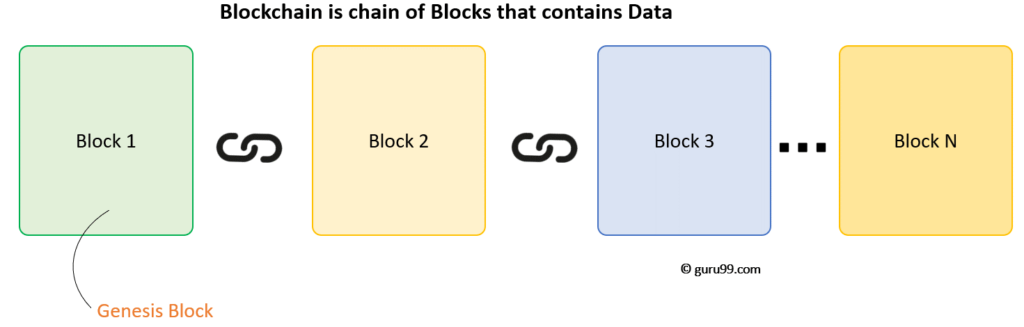
The intent of this article is to briefly describe what Blockchain is, dive in to how it works and touch on its potential use cases in Aviation. Blockchain can be defined as a growing list of records, called blocks, that are linked using cryptography. Each block contains a cryptographic hash of the previous block, a timestamp, and transaction data. By design, a blockchain is resistant to data tampering. It is "an open, distributed ledger that can record transactions between two parties efficiently and in a verifiable and permanent way".
In a nutshell, Blockchain is a global system for mediating trust and selective transparency.

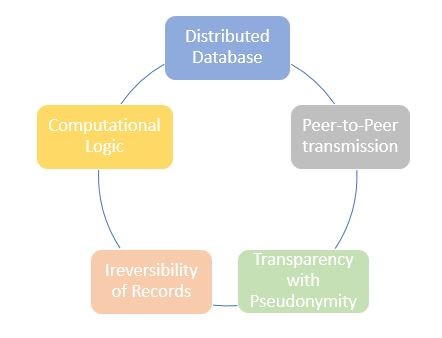
Here are five basic principles underlying the technology:
One of the key principles of Blockchain is its ledger and it is worthwhile to know how blockchain ledgers work. But before that lets take a brief look at traditional ledgers.

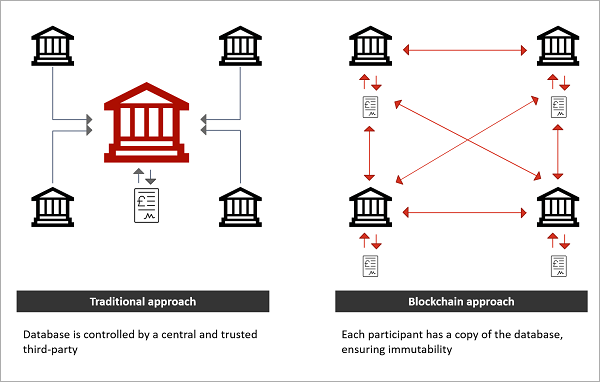
For centuries, banks have used ledgers to maintain databases of account transactions and governments have used them to keep records of land ownership. There is a central authority – the bank or government office – which manages changes to the record of transactions so they can identify who owns what, at any given time.
This allows them to check whether new transactions are legitimate, that the same $100 is not spent twice and houses are not sold by people who don't own them. Since users trust the manager of the ledger to check the transactions properly, people can buy and sell from each other even if they have never met before and do not trust each other. In this case, the middleman also controls access to information on the ledger. These ledgers are centralised and the middleman controls the system, the information and the transaction. The whole information is black boxed and is not fully visible to users.

Digitisation has made these ledgers faster and easier to use, but they remain centralised and black-boxed. Blockchain offers the same record-keeping functionality but without a centralised architecture or control. The question is how can it be certain that a transaction is legitimate when there is no central authority to check it. Blockchains solve this problem by decentralising the ledger, so that each user holds a copy of it. Anyone can request that any transaction be added to the blockchain, but transactions are only accepted if all the users agree that it is legitimate, e.g. that the request comes from the authorised person, that the house seller has not already sold the house, and the buyer has not already spent the money. This checking is done reliably and automatically on behalf of each user, creating a very fast and secure ledger system that is remarkably tamper-proof. Each new transaction to be recorded is bundled together with other new transactions into a 'block', which is added as the latest link on a long 'chain' of historic transactions. This chain forms the blockchain ledger that is held by all users. This is called 'mining'.

Blockchain can also be referred to as a data structure and that is, how data is logically put together and stored. Some other common data structures are databases (rows, columns, tables), text files, comma separated values (csv), images, lists, and so on.

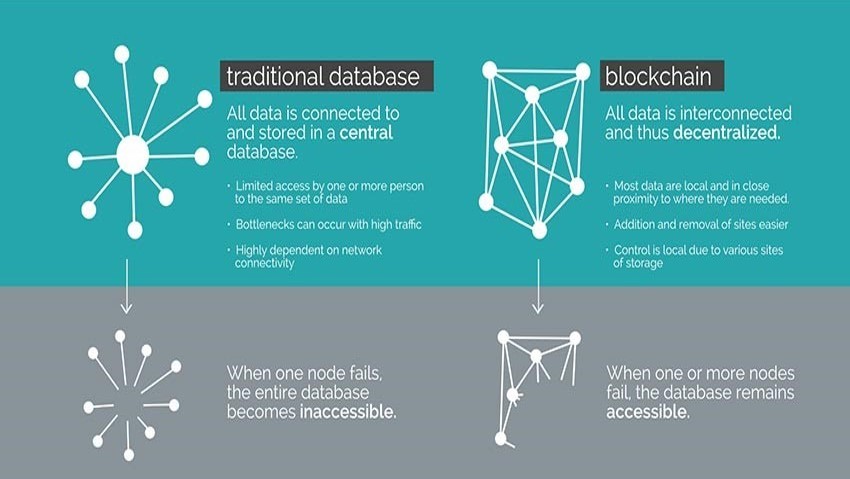
The core difference between a blockchain and a database is centralization. While all records secured on a database are centralized, each participant on a blockchain has a secured copy of records and all changes in ledger.  The true value of Blockchain is realized when there is an inconsistency — since each participant maintains a copy of the records, blockchain technology will immediately identify and correct any unreliable information.
One important question that usually arises is that who can use blockchain technology?

Blockchain technology has widely been associated with Cryptocurrencies because of Bitcoin.  However, bitcoin is only a small part of the blockchain technology’s footprint in the world. The potentials for blockchain implementation are endless, especially because it can be applied in virtually any field to accomplish important tasks such as;

·        Payment processing and money transfers

·        Monitoring and tracking supply chains

·        Retail loyalty rewards program

·        Digital Identification

·        Digital voting

·        Real Estate, land and auto title transfers

·        Food safety

·        Medical and drugs record keeping and tracking

·        Equity trading.

The world is only beginning to realize the vast opportunities and benefits offered by blockchain implementation with new potential uses being realized on a regular basis. The public blockchain continues to change how daily business is handled whereas the private blockchains allow companies to revolutionise their own internal processes for the better

Opportunities in Aviation

Commercial aviation is a complex industry due to the high number of stakeholders involved in delivering aviation related products and services. For example, it is estimated that from the time a passenger searches online for a flight to the time they arrive at their destination, approximately 26 stakeholders are involved in various steps of the passenger journey. Some key areas of opportunity are:

•       Earning, spending and accounting of frequent flyer points

•       Tracking and identification of baggage, cargo and spare parts

•       Distribution and payment across stakeholders

•       Passenger identification for seamless flow at the airport

•       Identification and tracking of visas and travel documents

•       Cargo supply chain

•       Tracking carbon offsets

•       Crew identity management.

There are several initiatives already underway in the aviation industry that are leveraging Blockchain. These include:

•     Aeron is working towards Blockchain application in Aviation Safety

•     Ozone has been positioned as an alternative distribution system for air transportation

•     SITA FlightChain is looking into maintaining a shared ledger on flight information with

participation of delegated authorities

•     Singapore Airlines’ Frequent Flyer Program is leveraging Blockchain to streamline

redeeming of points

Air France KLM has been testing Blockchain technology for aircraft maintenance.
While the value of Blockchain is quite strong, the approach has to be business outcome focused and remain solution-oriented throughout the process. Businesses often experience peer pressure to use certain methodologies or technologies but it’s the responsibility of the business to do enough due diligence to ensure that the initiative helps solve a business issue or opens up new business opportunities. The following decision tree is one of several available which can help in deciding if Blockchain is right for your business or not.
Hope that you liked the content, and feel free to contact me if you have any queries.
References
In January 2019, the world lost a great innovator. Herb Kelleher was a pioneer who totally reshaped the aviation industry. His vision revolutionized commercial aviation, democratized the skies and got me interested to study his leadership profile and share it with readers. He was an influence on my own leadership style, and he has much wisdom to impart. The following article looks at Kelleher’s leadership and how that affected his employees and overall business at Southwest Airlines.
Kelleher’s Leadership

The definition of leadership is open to any number of interpretations. According to Northouse (2018), leadership can be “a process whereby an individual influences a group of individuals to achieve a common goal.” Kelleher embodied Northouse’s statement and combined it with other approaches to create his own effective brand of leadership.

Influence as a concept is essential to successful leadership. Northouse (2018) writes: “leaders direct their synergies toward influencing individuals to achieve something together” (p. 7). Kelleher influenced his employees by having a clear vision and taking concreate steps to achieve it.

Cote’s (2015) analysis of Kelleher outlined the following:

In the simplest explanation of Herb Kelleher, he has developed a process of influencing and inspiring people to change. In this process, ethics is central to leadership and he has helped to establish and reinforce organizational values. In order to facilitate people to change, the following steps are essential in organizations like Southwest Airlines, which are: (1) leader creates a vision that is long-term, challenging, desirable, and compelling, (2) leader communicates the vision according to future change, (3) leader influences and inspires employees to be part of a culture based on morals, ethics, and core values, and (4) leader engages employees to increase productivity through empowerment.

Cote’s analysis was strong in its assessment of the importance of Kelleher’s vision in developing Southwest’s business model. Employees played a major role in this vision, so Cote is right in giving that aspect of Kelleher’s leadership that much value. However, where this analysis is lacking is in the description of Kelleher’s personal traits, outside of leadership style. To deliver leadership like Kelleher did, a person must possess high levels of intelligence and perseverance, of which he had both.

Creating a Vision for Southwest

A vision, in leadership, is a mental model of an ideal future state and has five characteristics: a picture, a change, values, map, and a challenge (Northouse, 2018, p. 142). At Southwest, Kelleher influenced followers by creating a vision and communicating it to gain support. His message was clear: “we’re going to give you more for less, not less for less. We’re going to give you new airplanes, not old airplanes. We’re going to give you the best on-time performance. We’re going to give you the people who are most hospitable” (Lucier, 2004). A high-level vision gives employees the opportunity to be innovative and creative in achieving optimal results. Kelleher’s vision had all five of Northouse’s characteristics, and that, in part, is why it was effective.
Leadership Style

A leader’s behavior is indicative of their leadership style, and Northouse (2018) defines leadership style as the behaviors of the leaders, focusing on what leaders do and how they act (p. 82). Behavior and style, therefore, influence one another greatly. Gaille (2013) identifies the core values of Kelleher’s leadership style: “one simple concept… ‘Be Yourself.’” Furthermore, Gaille (2013) identified four core values in Kelleher’s leadership style: 1) Do Good for Others; 2) Have Fun, Make a Difference; 3) Focus on the Customer; 4) Hire the Right People.

Kelleher's leadership style was quite opposite to some traditional leaders. He did not rule over his employees, but rather ruled with his employees. He also believed that leadership is not the job of only upper management, but of every employee within the organization, and that every employee should have the ability to ascertain situations and be able to act on their own decisions. Kelleher believed in the abilities of his employees to make leadership decisions, as long as they are experienced with the pertinent situation. This tactic of employee empowerment has been successful for Southwest. Southwest is based on the upside-down pyramid structure. At the top are the front-line employees who make things happen, and at the bottom is the senior management to support them (Shetty, 2011).

Despite Southwest’s impressive financial success, Kelleher made the decision to never increase his salary. He is quoted in an article by Elkins (2017): “I always turned down pay increases, bonus increases, to set a good example for all of our people, it's what I thought was a requirement of good leadership." On average in the United States, CEOs make 350 times more annually than the average employee (Ferdman, 2014). Kelleher went to the extent of taking a voluntary pay cut to avoid layoffs during the Gulf fuel crisis, a time when prices rose so much that airlines were losing money every time a plane took off (McGee-Copper & Looper, 2016). This decision was based on more than Kelleher’s respect and care for his employees.

McGee-Cooper and Looper (2016) outline the long-term effects of layoffs (illustration of concept in Appendix A):

Layoffs appear to work in the short term by significantly lowering overhead costs. But over time, employee morale and trust suffer, corporate memory and learnings get lost, productivity drops, and client and vendor relationships are damaged. Sales and profits fall, leading to even more layoffs.

Following Kelleher’s decision to avoid layoffs, Southwest employees pledged $1.3 million in payroll deductions to help recoup lost revenue (McGee-Copper & Looper, 2016).

Kelleher was also widely known for his philosophy of servant leadership, and he practised it with zeal. He would often wear Mickey Mouse ears during flights and assist flight attendants serving passengers, interacting directly with front-line employees and passengers, embodying humble, servant leadership (Walter, 2017). According to Greenleaf’s (2016) definition of a servant leader, “the servant-leader is servant first… It begins with the natural feeling that one wants to serve, to serve first. Then conscious choice brings one to aspire to lead”.

According to McGee-Cooper and Looper (2016), Kelleher’s motto for both Southwest employees and the airline as a whole wass: “Manage in good times to prepare for bad times.” To that end, the airline cross-trains employees to increase their skills in many aspects of the company so they have an in-depth understanding of many business areas, allowing them to take responsibility for keeping the airline competitive, enhancing relationships and finding innovative solutions. By doing so, Kelleher created an environment in which employees feel confident in implementing new programs, making decisions, and helping customers in need. One of Kelleher’s guiding principles was that if an employee has used his or her best judgement to do what is right, leaders will stand behind them (McGee-Copper & Looper, 2016).

Kelleher encouraged his employees to take risks, and if they failed, he encouraged to persevere, correct the mistake, and move on (Stanford Graduate School of Business, 2009). These qualities are usually identified in failure-tolerant leaders. “Failure tolerant leaders identify excusable mistakes and approach them as outcomes to be examined, understood, and built upon” (Farson, 2014). Traditional leaders tend to react in an opposite direction.

Kelleher’s leadership style has parallels to path-goal theory. Two specific pieces of the theory that he used are supportive and participative. He practised both of these behaviours by developing a personal relationship with as many employees as possible. He also strongly valued information received from the employees in his decision-making process, as employees who are actually dealing with the issues will have better insight than the most upper management (Kirubakran, 2012).

Clark (2014) defines the two leader behaviours employed by Kelleher as follows. The supportive leader “makes work pleasant for the workers by showing concern for them and by being friendly and approachable.” The participative leader “The leader consults with his followers before making a decision on how to proceed.”

Creating a Constructive Climate

Southwest has a history of innovation in the airline industry. For example, it introduced the low-cost carrier model into North American aviation. In order to succeed when taking risks, the leader of an organization – in this case, Kelleher – needs to establish a constructive climate. Northouse (2018) defines an organization’s climate as “people’s shared perceptions of the way things are in an organization” (p. 159).

Kelleher openly believed that between employees, customers, and shareholders; employees came first. He respected, honored, protected, and rewarded all employees, regardless of title and position. In turn, those employees, now empowered by the praise and respect, treated Southwest’s customers with that same care. The service provided to customers built brand loyalty and made sure they would continue flying Southwest, which in turn increased value for shareholders. A company-wide focus on customer service was one of the main differentiators for the airline from its competition. Kelleher said in HSMAmericas’ (2018) video that tangible things (e.g., aircraft) can be purchased by nearly any airline in the same capacity, but the intangible qualities (e.g., impeccable customer service) were difficult to replicate.

This type of leadership enabled the creation of the service-profit chain (SPC) model, which asserts “employee satisfaction soars when you enhance internal service quality (equipping employees with the skills and power to serve customers). Employee satisfaction in turn fuels employee loyalty, which raises employee productivity. Higher productivity means greater external service value for customers-which enhances customer satisfaction and loyalty” (Heskett et al., 2000).

Additionally, Kelleher emphasized enhancing communication processes within the organization, but not in the traditional top-down corporate style. As Kelleher said in HSMAmericas’ (2018) video, he made the effort to personally connect with employees, valuing them as individuals, not just as workers, celebrate with them, grieve with them, and involve himself in their personal and professional lives.
Competencies, Attributes, and Skills

Kelleher possessed a specific set of competencies that made him a successful leader, which are, according to Cote (2015):

(1) established an environment in which diversity, dignity and respect are valued, (2) developed a value-added leadership development program based on the philosophy “hire for attitude and train for skill”, (3) stayed in touch with employees through effective communication and sense of humor, (4) inspired through commitment, putting employees FIRST , (5) created a shared vision by influencing employees and translating that vision into action, and (6) developed innovative strategies keeping SWA a successful airline in a competitive marketplace.

According to Kelleher, there are six key personal attributes necessary for successful leadership: intelligence, health, optimism, perseverance, attention, and love for people. There are also seven skills that he believes are the most important contributors to success: good listening skills, broad knowledge and education, sound judgment, the ability to be a passionate advocate, the ability to separate important from unimportant things, the ability to be goal oriented with focus on priorities, and pleasant skepticism (Cote).

Herb leading Southwest with Innovation

Kelleher was an innovative leader and had introduced revolutionary ideas such as the 15-minute turnaround, one class of service instead of two or three classes of service, no pre-reserved seats, serving secondary airports instead of major hubs, no meals, and a single-model fleet to keep maintenance and training costs low. By doing so, he introduced a totally new business model to the airline industry, known commonly today as the low-cost carrier model (Stanford Graduate School of Business, 2009)

Spahr (2015) defines innovative leaders as leaders who “manage the process of innovation. In some cases, this leader is responsible for generating new ideas within an organization. In others, he or she is responsible for fostering and recognizing new ideas put forth by followers.”

Conclusion

Kelleher took Southwest Airlines to great heights until he stepped down from the CEO position in 2001. By using visionary and innovative leadership, he proved that one can totally revolutionize the industry and can innovate a new business model which is hard to imitate by its competitors. Kelleher clearly followed one of Porter’s (2004) generic strategies of competitive advantage, differentiation. “In a differentiation strategy, a firm seeks to be unique in its industry along some dimensions that are widely valued by buyers. It selects one or more attributes that many buyers in an industry perceive as important, and uniquely positions itself to meet those needs” (Porter, 2004).

 Kelleher battled for Southwest Airlines through legal challenges, budget crises, fare wars, and high fuel prices. He was always ahead of the industry and successfully steered the airline towards profitability for 44 consecutive years (Company Overview). He achieved all this success by having a clear vision for the airline, influencing his employees, and preparing them to change the normal norms of the industry. He also empowered his employees to make leadership decisions and learn and move on from their mistakes. He worked side by side with his employees, during flights serving passengers, or on the ground checking them in. This helped him to always be connected with the needs of both employees and passengers, and allowed him the insight to plan strategies that best aligned with what was actually needed.

By keeping employees at the forefront, Kelleher was able to increase employee satisfaction, which eventually led to repeat customer business of 100 million passengers per year and made Southwest the largest domestic carrier in United States.

Many other operators tried to copy the successful business model created by Kelleher, but failed, as they looked only at limited tangible aspects, whereas they should have focused at the full mosaic of his leadership style and strategy.

References

Biography.com Editors. (2014, April 02). Herb Kelleher. Retrieved October 16, 2017, from https://www.biography.com/people/herb-kelleher-278970

Company Overview. (n.d.). Retrieved October 10, 2017, from http://www.southwestairlinesinvestorrelations.com/our-company/company-overview

Clark, D. (2013, October 31). Path-Goal Leadership Theory. Retrieved October 10, 2017, from http://www.nwlink.com/~donclark/leader/lead_path_goal.html

Cote, B. (2015, October 13). Leadership Analysis: Southwest Airlines Flying High with Herb Kelleher, Former CEO. Retrieved October 10, 2017, from https://www.linkedin.com/pulse/leadership-analysis-southwest-airlines-flying-high-bob-cote-phd-mba/

Elkins, K. (2017, August 14). Why the Texas lawyer who started Southwest Airlines in 1967 never gave himself a raise or a bonus. Retrieved October 10, 2017, from https://www.cnbc.com/2017/08/14/herb-kelleher-never-took-a-pay-raise-or-bonus-at-southwest.html

Farson, R., and Keyes, R. (2014). The Failure-Tolerant Leader. Retrieved October 01, 2017, from https://hbr.org/2002/08/the-failure-tolerant-leader

Ferdman, R. A. (2014, September 25). The pay gap between CEOs and workers is much worse than you realize. Retrieved October 10, 2017, from https://www.washingtonpost.com/news/wonk/wp/2014/09/25/the-pay-gap-between-ceos-and-workers-is-much-worse-than-you-realize/?utm_term=.98e7dbee707b

Gaille, B. (2013, October 14). Southwest Airline's Herb Kelleher's Leadership Style. Retrieved October 10, 2017, from https://brandongaille.com/southwest-airlines-herb-kellehers-leadership-style/

Graham-Leviss, K., & Authors, V. (2017, May 03). The 5 Skills That Innovative Leaders Have in Common. Retrieved October 15, 2017, from https://hbr.org/2016/12/the-5-skills-that-innovative-leaders-have-in-common

Greenleaf, R. K. (2016). What is Servant Leadership? Retrieved October 10, 2017, from https://www.greenleaf.org/what-is-servant-leadership/

Heskett, J. L., Jones, T. O., Loveman, G. W., Sasser, W. E., Jr., & Schlesinger, L. A. (2000). Putting the service-profit chain to work. Boston, MA: Harvard College/HBR OnPoint.

HSMAmericas. (2008, October 14). Business of Business is People: Herb Kelleher. Retrieved October 10, 2017, from https://www.youtube.com/watch?v=oxTFA1kh1m8

Kelleher, H. (2016, October 20). How Southwest Airlines built its culture | Herb Kelleher | WOBI. Retrieved October 10, 2017, from https://www.youtube.com/watch?v=8_CeFiUkV7s.

Kirubakaran. (2012, October 26). Southwest Airlines Case Study - Case Study. Retrieved October 10, 2017, from https://www.allbestessays.com/English/Southwest-Airlines-Case-Study/34987.html

Lucier, C. (2004, June 01). Herb Kelleher: The Thought Leader Interview. Retrieved October 10, 2017, from https://www.strategy-business.com/article/04212?gko=8cb4f

Mcgee-Cooper, A., & Looper, G. (2016, January 15). Southwest Airlines: Does the "Soft Stuff" Work with Tough Problems? Retrieved October 10, 2017, from https://thesystemsthinker.com/southwest-airlines-does-the-soft-stuff-work-with-tough-problems/

Northouse, P. G. (2018). Introduction to Leadership: Concepts and Practice (3rd ed.). Thousand Oaks, CA: SAGE Publications.

Porter, M. E. (2004). Competitive advantage: creating and sustaining superior performance. New York: Free Press.

Shetty, N. (2011, May 4). Leadership Style at Southwest Airlines. Retrieved October 10, 2017, from http://www.managementparadise.com/forums/foundation-human-skills-f-h-s/221126-leadership-style-southwest-airlines.html

Spahr, P. (2014, November 25). What is Innovative Leadership? How Imagination Revolutionizes Business. Retrieved October 15, 2017, from https://online.stu.edu/innovative-leadership/

Stanford Graduate School of Business (2009, July 27). Herb Kelleher: Managing in Good Times and Bad. Retrieved October 14, 2017, from https://www.youtube.com/watch?v=wxyC3Ywb9yc

Vinnedge, M. (2015, September 22). From the Corner Office: Herb Kelleher. Retrieved October 17, 2017, from https://www.success.com/article/from-the-corner-office-herb-kelleher

Walter, E. (2017, June 8). In One Plane Ride, the Co-Founder of Southwest Airlines Teaches Us a Powerful Leadership Lesson. Retrieved October 10, 2017, from https://www.inc.com/ekaterina-walter/a-simple-but-powerful-leadership-lesson-from-the-co-founder-of-southwest-airline.html
INTRODUCTION
Beef is one of the biggest meat products consumed globally, and the world consumed 129.5 billion pounds of beef in 2016. Managing these kind of consumption volumes requires collaboration between Cattle farmers, slaughtering and meat processing plants, transportation and logistics, freight forwarders, veterinary physicians, insurance companies, airport handling, and regulatory agencies. As health awareness amongst the general population is increasing, there is more and more demand for transparency and visibility into how the animal has been raised, how the animal was treated medically, how the animal was slaughtered and how the meat was processed and handled under different environment conditions all the way from the slaughter house to the grocery store, or as steak on your table in the restaurant!

The current beef export market and supply is riddled with major problems, such as lack of traceability of the beef back to the birth farm, poor transparency, price volatility, non-compliance to export laws, poor quality control standards, absence of traceability in transactions and poor correlation between cost and quality of the product. The following diagram illustrates the high-level steps in the meat export chain.
There are three different ways to consider the problem:

1. The problems farmers face with buying and selling livestock.

The first problem is faced at the beginning of a cow’s life. This is a time where an animal may need medical attention and may be given drugs. In this case these drugs need to be carefully monitored and recorded as so   they don’t enter the supply chain. Without this information a cow cannot be slaughtered and processed for human consumption.

2. The problems faced with meat importation and exportation

The second problem faced is a problem because different countries have different rules and regulations governing meet imports or exports. This causes great confusion and there are many forms, documents and regulatory bodies involved in making this process happen. The process is also labor intensive and slow, making it a necessary but expensive exercise.

3. Food traceability

The third problem is food traceability. When a customer is buying a product from the shelf they have no way of knowing where that meat has come from, how long it has taken to get there, or how ethically it was sourced and raised. Sure, there are organic meats on the market however many of the cattle involved in the beef industry only need to be out for two weeks to be classed as free range and drug free for a short period of time before that are classed as organic. The customer needs a way of knowing and understanding exactly where a product has come from and its history.

BLOCKCHAIN SOLUTION
To solve the above-mentioned problems, I propose a blockchain solution. The solution at its core will use a distributed, decentralized immutable ledger to store all the information about an animal from birth to its final state (to a store or to a restaurant). The immutable nature of the ledger ensures that the data collected throughout the animal’s value chain cannot be tampered with, and in addition, at any point of the value chain, the transactional information within the block helps us identify the true ownership of the animal.

Blockchain is more than the next viral buzzword. Blockchain technology provides a feasible solution to some of the biggest problems that supply chains currently face such as lack of transparency and accountability, by providing a solution that can enable the transfer of titles of goods, recording of permissions and activity logs as well as real time data updates using internet enabled devices, thereby eliminating the need to reconcile and minimizing errors across complex value chains.

Digital Tokens can be attached to intermediate goods as they progress through the supply chain, while smart contracts enable automatic payments to respective parties based on delivery of goods, and also ensure that vendors and employees along the supply chain are carrying out the necessary checks and balances to ensure the quality of   the product. One of the biggest advantages of the Blockchain network is that it is able to anonymize data except to the participants with the right amount of access. This is critical in terms of protecting farmers by not giving away the farmers location to the general population while providing health information, but at the same time providing this sensitive information to required stakeholders like Centre for Disease Control (CDC) if there is a disease outbreak.

ARCHITECTURE
The blockchain solution could be a permissioned network built on Hyperledger framework. Hyperledger Fabric can   be a preferred solution as we have specific identifies for all our participants and the architecture of Hyperledger  easily enables the permissioned network for known identities and associates specific levels of access to each of the participants. This means that participants can only view and update the data that they have access to and will not see all of the transactions within a block. Moreover, instead of having to create static identities for each participant into our solution, Hyperledger also enables “Bring your own Identity” which is key to our use case where the entities in   the supply chain may be constantly changing and already have existing identity management systems.
Hyperledger is also much more scalable than its counterparts as it is built on a modular architecture that separates the chaincode from the transaction validation portion, decreasing the processing time and energy utilized for consensus. The architecture also enables a “pluggable consensus” which means that the consensus mechanism is decoupled from the participants who are involved in the actual maintenance of the ledger improving performance and in addition enabling a variety of consensus mechanism options from BFT (Byzantine Fault Tolerance) to the more CPU intensive PoS (Proof of Stake).

MARKET ANALYSIS AND TARGET CUSTOMERS
Canada is one of the world’s largest global exporters of red meat. On average Canada is the 12th highest producer of beef globally. January 2017 statistics as stated by Statistics Canada suggest that in 2016 Canada produced 1.9 percent of the world’s beef supply exporting 360 million kilograms and importing 186 million kilograms of beef in total, thus contributing on average 16 billion dollars to Canada’s GDP (Gross Domestic Product) between 2012 and 2016. Furthermore, Canadian exports were valued at 2.23 billion dollars in 2015 and grew by another 2 percent in 2016 to 2.27 billion dollars.

The image below illustrates some Canadian trade routes and depicts where Canada fits in the global market (Source: 2017 Statistics Canada).
Beef is slaughtered in one of two ways - The cows are either sent directly to the slaughter house by the farmer or are sent to market and bought by a “meat” or “kill” buyer. If a farmer decides to slaughter their cattle directly a meat buyer will buy the meat from them directly. Depending on the grading of the beef the farmer will be paid per kg of meat or deadweight. This is usually slightly higher than if a buyer buys a cow as live weight because the animal    is heavier when it has all of its organs and bones. Having said this, this is a farmer’s preferred way of slaughter as   it’s a more reliable way of guaranteeing a consistent and regular price for your meat as it eliminates the extraneous variables of beef grading and dead weight outcomes.

Extraneous variables play a huge part in the beef industry and a lot hinges on unknowns. A blockchain solution plans on helping its customers to eliminate some of the unknown variables to more reliably trade and track meat. This will help the farmers, buyers, sellers and handlers anywhere in the chain

There are seven different target segments involved (as stakeholders
CONCLUSION
With an industry as prominent in Canada as beef production, implementing a blockchain solution to the supply chain can significantly improve processes around buying and selling, importing and exporting, and food traceability. The solution at its core will use a distributed, decentralised immutable ledger to store all the information about an animal from birth to its final state (to a store or to a restaurant). The immutable nature of the ledger ensures that the data collected throughout the animal’s value chain cannot be tampered with, and in addition, at any point of the value chain, the transactional information within the block helps us identify the true ownership of the animal. All these benefits create a strong argument for implementing a blockchain solution in the beef supply chain.

REFERENCES
BEEF2LIVE.COM/STORY-WORLD-BEEF-CONSUMPTION-PER-CAPITA-RANKING-COUNTRIES-0-111634

BEEFRESEARCH.ORG/CMDOCS/BEEFRESEARCH/BEEF%20GRADING.PDF

NCBI.NLM.NIH.GOV/PMC/ARTICLES/PMC4006171/

WORLDSTOPEXPORTS.COM/TOP-BEEF-EXPORTING-COUNTRIES/

CATTLE.CA/CCA-RESOURCES/INDUSTRY-STATS